Everest Base Camp Trek with Family and Kids
View More Images

Everest Base Camp Trek with Family and Kids - 16 Days

49 reviews in Trip Advisor
Recommended by 99% of travelers
Trip Facts
Duration
16 Days
Trip Grade
Strenuous
Country
Nepal
Maximum Altitude
5,555 m.
Group Size
1 - 12 Pax
Starts
Kathmandu
Ends
Kathmandu
Activities
Trekking & Hiking
Best Time
Mar - May/ Sep - Nov

The Everest Base Camp Trek with Family and Kids is a 16-day Himalayan adventure designed for active families who want to explore Mount Everest together.

Comparing EBC options? See our classic 14-day Everest Base Camp Trek itinerary and price.

The journey takes you through Sherpa villages, suspension bridges, Buddhist monasteries, and beautiful mountain valleys before reaching Everest Base Camp at 5,364 meters (17,598 feet).

Families travel with experienced local guides, follow a gradual trekking itinerary, and take planned acclimatization breaks. Although children can participate, the high altitude makes this a strenuous adventure that requires medical advice, physical preparation, flexible planning, and careful supervision throughout the trek.

Everest Base Camp Trek with Family and Kids – 16 Days Trip Highlights

  • Family Adventure to Everest Base Camp (5,364 m) – Share an unforgettable journey with your family to the base of the world's highest mountain, Mount Everest.
  • Scenic Flight to Lukla – Enjoy a thrilling mountain flight with spectacular views of the Himalayas as your adventure begins.
  • Explore Namche Bazaar – Discover the vibrant Sherpa town, traditional markets, local bakeries, and fascinating mountain culture.
  • Discover Sherpa Culture and Traditions – Visit traditional villages, Buddhist monasteries, prayer wheels, and colorful prayer flags while learning about Himalayan life.
  • Family-Friendly Acclimatization Days – Allow time to adjust to the altitude, explore nearby villages, and enjoy gentle walks together.
  • Panoramic Himalayan Mountain Views – Admire breathtaking views of Everest, Lhotse, Nuptse, Ama Dablam, and other spectacular Himalayan peaks.
  • Visit Tengboche Monastery – Experience the peaceful atmosphere of one of the Khumbu region's most renowned Buddhist monasteries, surrounded by dramatic mountain scenery.
  • Stand at Everest Base Camp – Celebrate a remarkable family achievement at the legendary starting point for Everest expeditions.
  • Sunrise from Kala Patthar (5,545 m) – Witness an unforgettable sunrise over Mount Everest and the surrounding Himalayan giants, weather permitting.
  • Quality Family Time in the Himalayas – Build lasting memories through shared trekking experiences, cultural discoveries, beautiful landscapes, and personal achievements.

A Family Adventure to Everest Base Camp That Goes Beyond the Mountains

Imagine walking across a suspension bridge with your children, sharing hot chocolate in a mountain teahouse, and watching the first sunlight reach the snowy peaks above the Khumbu Valley.

A family trek to Everest is about much more than reaching a famous destination. It is an opportunity to explore a different culture, build confidence, and spend meaningful time together.

But planning an Everest Base Camp Trek with family and kids comes with important questions. Is the altitude suitable for children? How difficult are the walking days? What happens if someone becomes sick or tired? How much should a family budget?

At Overland Trek Nepal, our 16-day family trekking package focuses on thoughtful planning, experienced local support, and a flexible approach to the journey. Reaching base camp is the goal, but your family's health and enjoyment always come first.

Can You Trek to Everest Base Camp with Kids?

Yes, some children can complete the Everest Base Camp Trek with their families, but it is not suitable for every child. The route reaches 5,364 meters, where altitude illness can affect healthy, active children and adults. A family should seek pediatric travel-medicine advice, choose a gradual itinerary, and remain prepared to turn around. Trekking experience, maturity, and the ability to explain symptoms matter more than age alone.

Planning your family's trip? Contact us via email or WhatsApp us at +9779841920870

Why Choose an Everest Base Camp Trek with Family?

A family trek should never be treated as an ordinary Everest Base Camp itinerary with a few extra breaks.

Adults traveling alone can sometimes adjust their plans around long walking days, shared group schedules, and limited rest. Parents have more to consider. Children may walk at different speeds, lose interest during difficult sections, need familiar meals, or struggle to explain how they feel at altitude.

A thoughtfully organized family trip accounts for these challenges before the trek begins.

1. Private Trekking Gives Your Family More Control

A private trip allows the guide to focus on your family's needs instead of balancing the expectations of unrelated trekkers.

You can stop for photos, rest at a teahouse, or shorten an activity when necessary. Children can explore their surroundings without feeling pressure to keep up with faster adults.

However, private guiding does not remove the physical demands of the trail or allow unsafe altitude gains. Any changes to your schedule must still respect proper acclimatization.

2. Children Need More Than a Shorter Walking Day

Walking hours are only one part of the challenge.

A child who manages a five-hour hike at home may respond differently after several nights at 4,000 meters. Cold temperatures, poor sleep, unfamiliar food, and reduced oxygen can affect how children feel.

Our approach emphasizes realistic daily distances, accessible rest stops, and regular communication between parents and the trekking guide.

3. The Experience Can Be Educational

The Everest region becomes a living classroom.

Children discover how mountain communities transport supplies, why Himalayan forests change with elevation, and how Buddhism influences village life.

They encounter prayer wheels, mani stone walls, monasteries, and traditional Sherpa settlements. These experiences give families something meaningful to share long after returning home.

4. A Family Trek Needs an Exit Plan

No itinerary can guarantee that every participant will reach Everest Base Camp.

A responsible family trek must allow for rest, retreat, or descent if symptoms develop. Guides and parents should agree on decision-making before departure.

For larger families, ask whether the guiding arrangements allow an unwell child and accompanying adult to descend while other family members continue. This should be discussed and priced in advance, not assumed.

Is the Everest Base Camp Trek Safe for Children?

Everest Base Camp is a high-altitude trekking destination, not an easy family vacation. Children face altitude-related risks similar to adults, and good fitness does not protect against altitude sickness. Families can manage risk through gradual ascent, appropriate medical preparation, experienced guidance, and a willingness to descend. No guide, medication, or itinerary can make the trek completely risk-free.

The biggest concern when trekking to Everest Base Camp with kids is not simply whether they can walk far enough. It is whether their bodies adapt to altitude.

At Everest Base Camp, the air pressure is much lower than at sea level. This reduces the amount of oxygen available with each breath. Even strong hikers can develop acute mountain sickness (AMS).

What Is the Right Age for Children to Trek to Everest Base Camp?

There is no single age at which Everest Base Camp becomes safe for every child. However, children of 8 years minimum or older are suggest to attempt the EBC Trek with their family.

Before confirming a family booking, consider these factors:

  • Can your child comfortably handle repeated hiking days?
  • Have they completed an overnight or multi-day trek before?
  • Can they clearly describe headaches, nausea, dizziness, and breathing problems?
  • Are they comfortable sleeping in basic mountain accommodations?
  • Do they understand that the family might have to turn around?
  • Has a pediatrician or travel-medicine professional assessed their suitability for extreme altitude?

Families with infants, toddlers, or children who cannot reliably describe symptoms should not assume that being carried makes the journey safe. Carrying a child does not protect them from altitude illness.

For younger children, a lower-altitude Everest-region trek is usually a more sensible option to discuss.

Family Trek to Everest Cost details for 2027,2028

The Everest Base Camp family package starts at US$1,899 per person, with lower per-person rates for larger groups. For 2027, you can request a current private quote because prices depend on the number of adults and children, accommodation, flights, staffing, and itinerary changes. The cost of the EBC Trek with family for a group of 2-3 pax is around USD 1749 per person. Likewise, a family group of 4-7 costs around USD 1699 per person.

Group subtotals are calculated using the published per-person rates. They assume the same adult price for every participant and exclude personalized child pricing or optional extras.

Send Overland Trek Nepal your preferred month, number of adults, children's ages, and ideal trip duration. Request one complete quotation with any child-specific arrangements clearly listed. Contact us via email or WhatsApp us at +9779841920870.

Itinerary

Embark on the Everest Base Camp Trek with Family and Kids, a carefully designed adventure that ensures safety, comfort, and enjoyment for all ages. This trek combines breathtaking mountain views, rich cultural experiences, and manageable walking distances suitable for families. Departing every morning, we follow a flexible itinerary that prioritizes your family’s comfort and pace.

If this plan doesn’t align with your holiday schedule, we are happy to customize it to fit your needs, ensuring a hassle-free and memorable journey. At Overland Trek Nepal, we prioritize your comfort and deliver a family-friendly trekking experience. Book now for a trip that combines adventure, bonding, and the awe-inspiring Himalayas.

Tour PlanExpand all

Upon arrival at Tribhuvan International Airport in Kathmandu, you will be warmly welcomed by a representative from Overland Trek Nepal. After completing airport formalities, you will be transferred to your hotel in Thamel, the main tourist hub of Kathmandu. You can rest and recover from your long journey to Nepal.

In the evening, attend a briefing session at the office about the trek led by a trekking expert and get introduced to your trek guide.

Afterwards, you can explore Thamel, a lively tourist area, and enjoy its main attractions. Dinner options in Kathmandu are varied, including Nepali dal bhat and international cuisines.

Overnight stay at a hotel in Kathmandu

Max Altitude: 1,400 m. Meals: N/AAccommodation: 3-Star Hotel in KathmanduDistance: 8Km/ 20 min to Thamel

Highlights of the day

  • Early morning Scenic 30-minute mountain flight to Lukla with breathtaking Himalayan views
  • Lukla, a gateway to the Everest Base Camp Trek
  • The trek starts towards Phakding, descending through pine forests and Sherpa villages
  • Phakding is a popular rest stop along the EBC Trekking route on the banks of Dudh Koshi.

After an early wake-up, enjoy a light breakfast at your hotel before heading to the airport or choosing the packed breakfast option for a scenic 35-minute flight to Lukla. This flight provides breathtaking views of the Himalayas as you reach Lukla.

Upon landing at the world’s most dangerous airport, Lukla Airport, meet your porters and begin your trek to Phakding. The route winds through pine forests and picturesque Sherpa villages. Lunch will be served at a local teahouse, offering options like fried rice, noodles, or soup.

After 3-4 hours of walking, covering around 8 km, arrive at Phakding. It is a popular night camp along the EBC Trekking route, which offers well-facilitated teahouses. Also, Experience Sherpa culture, hospitality, and mountain lifestyle.

Note: Due to weather and the busy season, most flights will depart from Ramechhap to Lukla if you make a last-minute booking. You can share transportation from Kathmandu to Ramechhap, then take the flight to Lukla.

Overnight stay at the teahouse in Phakding

Max Altitude: 2,840 m. Meals: Breakfast, Lunch & DinnerAccommodation: Guest HouseDistance: 8km / 3-4 hrs

Highlights of the day

  • The trek starts at 8 AM and ends at around 3 PM
  • Walk through pine forests and traditional Sherpa villages like Toktok and Monjo
  • Cross multiple suspension bridges decorated with prayer flags
  • Observe the authentic Sherpa lifestyle and local culture along the trail
  • Jorsale is a peaceful settlement perfect for relaxation and acclimatization.

Wake up early and have a delicious breakfast before beginning the trek at 8 AM and following the Dudh Koshi River, crossing several suspension bridges adorned with prayer flags. The trail passes through pine forests and small villages like Toktok and Monjo, where you can witness the daily lives of the Sherpa people.

Arrive at Monjo, where your permits are checked, and enjoy your lunch here before continuing your trek. After walking for 3-4 hours and covering 6 km, you reach Jorsale, a small settlement with a peaceful atmosphere. Spend the evening resting and acclimatizing.

Overnight at a teahouse in Jorsale

Max Altitude: 2,740 m. Meals: Breakfast, Lunch & DinnerAccommodation: Guest HouseDistance: 6km/3-4 hrs

Highlights of the day

  • The trek starts at 8 AM and ends at around 3 PM
  • The trail continues alongside the scenic Dudh Koshi River
  • Cross several suspension bridges, including the iconic Hillary Suspension Bridge
  • Namche Bazaar, the vibrant gateway to the Everest region

After breakfast, start your trek at 8 AM, following the trail along the Dudh Koshi River. Today’s trail towards Namche Bazaar involves crossing various suspension bridges, including the popular Hillary Bridge.

Covering the distance of 4-5 hours through the Sagarmatha National Park, reach the vibrant Namche Bazaar. It is the popular gateway to the Everest region, featuring well-facilitated and luxurious amenities and hotels.

Overnight stay at the teahouse in Namche Bazaar

Max Altitude: 3,440 m. Meals: Breakfast, Lunch & DinnerAccommodation: Guest HouseDistance: 5km/3-4 hrs

Highlights of the day

  • Dedicated an acclimatization day to adapt to the higher altitude
  • Morning hike to the Everest View hotel and the Khumjung Valley
  • Stunning views of the world’s tallest Mount Everest (8848.86m), Ama Dablam (6812m), and surrounding peaks
  • Visit the Sherpa Culture Museum or explore Namche Market
  • Learn about Sherpa traditions, lifestyle, and mountaineering heritage

This day is dedicated to acclimatization to help your body adjust to the altitude. After breakfast, take a short hike to the Everest View Hotel, the highest altitude hotel in the world. From here, enjoy the stunning panoramic views of Mt. Everest, Ama Dablam, and other peaks.

Afterwards, visit the Khumjung Valley, where you can visit the Khumjung Monastery and the Yeti Skull. Enjoy your lunch in this beautiful valley, learning about the Khumbu region’s history and culture before descending to Namche.

In the late afternoon, you can visit the Sherpa Culture Museum or explore the market. The Sherpa people here are known for their rich traditions and mountaineering expertise.

Stay overnight at a teahouse in Namche

Max Altitude: 3,880 m. Meals: Breakfast, Lunch & DinnerAccommodation: Guest HouseDistance: 6km/4-5 hrs

Highlights of the day

  • The day starts at 7 AM and ends at around 3 PM
  • The trail gradually ascends through the small settlements like Sanasa, Tashinga, and Phungi Thenga
  • Steady climb through lush rhododendron forests toward Tengboche
  • Tengboche, a spiritual center of the Everest region
  • Visit the renowned Tengboche Monastery, the largest monastery in the area

After an early breakfast, leave Namche Bazaar at 8 AM following the iconic Everest Base Camp Trekking route. The trail descends to the Dudh Koshi River and crosses the suspension bridge and then climbs through rhododendron forests to Tengboche.

Along the trail, enjoy the stunning views of Everest, Ama Dablam, Kusum Kangaru, and Thamserku. While passing through the small settlements such as Sanasa, Tashinga, and Phungi Thenga, experience the local culture and tradition.

Upon reaching Tengboche, a spiritual center of the Everest region located at the base of Mount Khumbila (5761m), which is considered the god of Khumbu in Tibetan tradition, visit the Tengboche Monastery in the late afternoon. This monastery is the oldest and largest in the Khumbu region.

Overnight stay at the teahouse in Tengboche

Max Altitude: 3,860 m. Meals: Breakfast, Lunch & DinnerAccommodation: TeahouseDistance: 10km/4-5 hrs

Highlights of the day

  • Trek begins at 8 AM and ends at around 3 PM
  • Gradual ascent to Pangboche, one of the oldest Sherpa settlements
  • Enjoy impressive views of Ama Dablam and the surrounding peaks
  • Dingboche, a scenic high-altitude village with traditional stone-walled fields and a local mountain lifestyle

Start your day with breakfast at 7 AM and begin your trek at 8 AM. The trail descends through forests to Deboche and crosses the Imja Khola River before ascending to Pangboche.

Pangboche is one of the oldest settlements in the Khumbu region, where you get the opportunity to immerse yourself in the Khumbu region’s history and lifestyle. After lunch, continue the trek through the alpine meadows and yak pastures. The 4-5 hours of walking take you to Dingboche.

Dingboche is a picturesque village with stone-walled fields and views of surrounding peaks. The local people here rely on farming and tourism.

Overnight at a teahouse in Dingboche.

Max Altitude: 4,410 m. Meals: Breakfast, Lunch & DinnerAccommodation: TeahouseDistance: 11km/5-6 hrs

Highlights of the day

  • Dedicated acclimatization day to adjust to the higher altitude
  • Optional hike to Nagarjun Hill, which offers stunning views of natural landscapes
  • Spectacular views of Mt Makalu and the surrounding Himalayan peaks
  • Explore Dingboche village, experiencing the high-altitude lifestyle and farming traditions

This acclimatization day includes a hike to Nagarjun Hill, offering stunning views of Makalu, Ama Dablam, Thamserku, Lobuche East, Lobuche West, and other peaks. The hike takes 4-5 hours and covers 4.5 km for a round trip.

After the hike, explore Dingboche, one of the oldest settlements in the Khumbu region. Spend the time experiencing the high-altitude lifestyle and farming traditions. Locals primarily engaged in potato and barley cultivation and herding.

Overnight stay at the teahouse in Dingboche

Max Altitude: 5,100 m. Meals: Breakfast, Lunch & DinnerAccommodation: TeahouseDistance: 5km/4-5 hrs

Highlights of the day

  • Early breakfast followed by an 8 AM trek start
  • Gradual ascent along the high-altitude trail toward Thukla
  • Steep ascent to the Everest Memorials, honoring fallen climbers
  • Impressive views of Nuptse and Pumori along the trail
  • Lobuche, a small settlement with basic teahouses

After breakfast, start the trek at 8 AM. The trail ascends gradually to Thukla, witnessing the spectacular views of Nuptse and Pumori. Afterwards, the trail leads through the Everest Memorials, honoring the climbers who lost their lives on Everest.

The final stretch to Lobuche is relatively flat. The trek takes 5-6 hours and covers around 8 km. Lobuche is a small settlement with basic teahouses.

Overnight at a teahouse in Lobuche

Max Altitude: 4,910 m. Meals: Breakfast, Lunch & DinnerAccommodation: TeahouseDistance: 8km/5-6 hrs

Highlights of the day

  • The trek starts at 7 AM and ends at around 4 PM
  • Trekking trail along the Khumbu glacier and moraines
  • Gorakshep, the last stop of the EBC Trek
  • Witness the magnificent views of towering mountain peaks such as Mt Everest, Lhotse, Lopuche Peak, Nuptse, Pumo Ri, Khumbutse, and many more
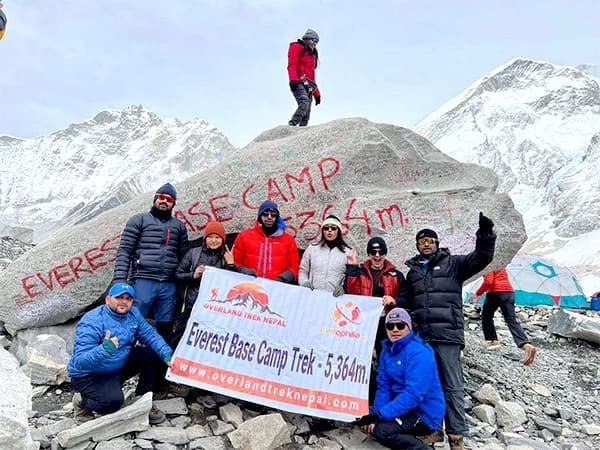
  • Hike to the iconic Everest Base Camp at 5364m
  • Spectacular views of the Khumbu Glacier and Khumbu Icefall

Today is a comparatively long day as you hike to Everest Base Camp via Gorakshep. Wake up early, have breakfast, and begin your trek around 7 AM. The route crosses the Khumbu glacier toward Gorakshep, with stunning views of surrounding peaks. Though the trail is mostly flat, high altitude might make walking challenging. The 2–3-hour walk takes you to Gorakshep, the final stop before reaching Everest Base Camp.

Enjoy your lunch with views of majestic peaks before heading to Everest Base Camp. Leave any heavy belongings in the lodge and continue along the glacier and moraines. It will take another 2-3 hours to reach Everest Base Camp, which is at 5364m.

After reaching the base camp of Mount Everest (8848.86m), take photos of the unforgettable moments and then descend the same route back to Ghorashep.

Overnight stay at the tea house in Gorakshep.

Max Altitude: 5,364 Meals: Breakfast, Lunch & DinnerAccommodation: TeahouseDistance: 12km/7-8 hrs

Highlights of the day

  • Early morning hike to Kala Patthar for breathtaking sunrise views
  • Panoramic vistas of surrounding mountains, including Mount Everest, Lhotse, Nuptse, and Pumori
  • Descending trek toward Pheriche, a quiet village known for its health post

After an early breakfast, get ready for a challenging 6 AM hike to Kala Patthar, the highest point of our Everest Base Camp Trek. The summit of Kala Patthar, which stands at 5545 meters, takes about 2 hours to reach. It provides the perfect viewpoint for a close and clear view of Mount Everest along with surrounding peaks, such as Lhotse and Nuptse. Enjoy the 360-degree panorama of the mountain peaks and take photos from the top before heading back down to Gorakshep.

After a short rest at Gorakshep, your return journey begins along the same route on the Khumbu glacier and moraines to Lobuche. Have lunch there, and follow the trail that descends to Pheriche, a small village with guesthouses and lodges for acclimatization.

Overnight stay at the teahouse in Pheriche

Max Altitude: 5,555 m. Meals: Breakfast, Lunch & DinnerAccommodation: TeahouseDistance: 12km/6-7 hrs

Highlights of the day

  • Morning breakfast followed by an 8 AM descent
  • Retrace scenic trail through Pangboche and Tengboche
  • Enjoy final panoramic views of Mount Everest and Ama Dablam
  • Long but rewarding downhill trek through forests and valleys

Begin your day with breakfast at 7 AM, then start your return trip at 8 AM. The trail gradually descends along the Imja Khola, offering stunning natural views. It leads to Pangboche, the oldest village in the Khumbu region. Spend some time exploring the village and interacting with locals to gain a better understanding of its history and culture.

Afterwards, cross the suspension bridge and follow the gradually ascending trail through the lush green forest to Tengboche. This small village at the foot of sacred Mt. Khumbila (5761m) is home to the Tengboche Monastery, a Buddhist center in the Everest Region.

Following lunch at Tengboche, the trek heads down to Phungi Thenga and then follows a flat trail to Namche Bazaar. This lively Himalayan town serves as a tourist center, offering great relaxation spots like coffee shops, cafes, pubs, and bars.

Overnight stay at the teahouse in Namche Bazaar

Max Altitude: 3,440 m. Meals: Breakfast, Lunch & DinnerAccommodation: Guest HouseDistance: 15km/6-7 hrs

Highlights of the day

  • Trek begins around 8 AM and ends at around 3 PM
  • Scenic downhill trail with views of snow-capped peaks and the Dudh Koshi River
  • Chances to see yaks and mule caravans along the route
  • Cross multiple suspension bridges decorated with prayer flags

The day starts early in Namche Bazaar with a hearty breakfast. By 8 AM, the trek down toward Phakding begins. This descent is scenic, with the trail offering stunning views of snow-capped peaks and the flowing Dudh Koshi River. Pass through forests of rhododendrons and pines, and you might encounter yaks and mule caravans along the way.

The walk, lasting approximately 6-7 hours and covering around 10 km, includes crossing suspension bridges decorated with colorful prayer flags. As you approach Phakding, notice the peaceful beauty of the area, with its small stone houses and lush greenery. Once you arrive, you can rest and explore the village, surrounded by mountain views and the calm sound of the river.

Overnight stay at the teahouse in Phakding

Max Altitude: 2,610 m. Meals: Breakfast, Lunch & DinnerAccommodation: Guest HouseDistance: 10km/6-7 hrs

Highlights of the day

  • The trek starts at 8 AM and ends at around 3 PM
  • Final trekking day following the Dudh Koshi River back to Lukla
  • Gentle ascent with last views of the Himalayan landscape
  • Pass through local villages like Ghat and Toktok, witness the daily village life, terraced farming, and teahouse culture
  • Explore the lively Lukla village and reflect on the journey

The final day of trekking starts with an early wake-up around 7 and a hearty breakfast at the teahouse. The return trek to Lukla, which takes about 3-4 hours covering 8 km, follows the same path along the Dudh Koshi River. The trail gently ascends and offers the last views of the Himalayan scenery you’ve been surrounded by.

The journey takes you through small villages like Ghat and Toktok, where you can observe locals engaged in their daily routines. Agriculture and tourism are the main sources of income here, and you might see terraced fields and teahouses busy with activity.

After arriving in Lukla, take time to explore the lively village and reflect on your amazing journey. Spend the evening relaxing and celebrating with your support team over a delicious dinner, looking forward to creating lifelong memories and the flight back to Kathmandu the following day.

Max Altitude: 2,840 m. Meals: Breakfast, Lunch & DinnerAccommodation: Guest HouseDistance: 8km/3-4 hrs

Highlights of the day

  • Early morning breakfast before departure
  • Scenic 35-minute flight from Lukla to Ramechhap or Kathmandu
  • Stunning aerial views of Nepal’s diverse landscapes
  • Evening farewell dinner hosted by the company

After an early breakfast, take a 35-minute flight back to Ramechhap or Kathmandu, enjoying the final views of the Himalayas. Upon arrival, you will be transferred to your hotel in a private vehicle. The rest of the day is free to explore or relax. By Evening, the Company organizes a farewell dinner and appreciates you with some of the company’s merchandise along with a trek completion certificate.

Overnight at the hotel in Kathmandu

Max Altitude: 1,400 m. Meals: Breakfast & DinnerAccommodation: 3-Star Hotel in KathmanduDistance: 35 min/20 min

Today marks the end of your Nepal journey. If time allows, you can have one last chance for some shopping or sightseeing. This is the final day of your adventure, as you head to Tribhuvan International Airport, with a promise that we’ll welcome you back on your next journey!

Max Altitude: 1,400 m. Meals: BreakfastAccommodation: N/ADistance: 20 min to Airport
Route Map
Everest Base Camp Trek with Family & Kids
Altitude Chart
Everest Basde Camp Trek with Family & Kids
Cost Details
Required Permits & Documents
  • Your PP Size Photo 2 Copy
  • Your Passport & Nepal Visa Copy
  • Everest National Park entry permits
  • Khumbu Region Municipality Entry Permit Fee.
  • TIMS Card (Trekkers Information Management system)
Meals & Snacks
  • Three meals a day (Breakfast, Lunch, Dinner)
  • Fresh Seasonal Fruits as a dessert after Dinner
  • Farewell dinner in Kathmandu at the end of the trek.
  • Snickers, Bars, Chocolate, and cookies for each person during the trek
Accommodation
  • Two-night accommodation in Kathmandu with breakfast in 3-star Hotel
  • Tea house/ Local Guest House Twin Sharing basis during the trek
Staffs & Crew Member
  • Government Licensed Holder very well English speaking Overland Trek Nepal experienced trekking Guide/leader.
  • Experienced & Strong porters to help trekkers with luggage. (2 trekkers will share a porter) Max load 20 kg per porter.
  • All the Expenses ( Accommodation, Food, Salary, Transport, Insurance, Medicin) of All Staff & Crew member
Transportation
  • Airport pick-up and drop by private vehicle
  • Domestic Airport Pickup & Drop
  • Domestic flight ticket round trip and airport tax Kathmandu/Ramechhap to Lukla and back to Kathmandu/Ramechhap
Others
  • Trekking Map
  • All government and local taxes
  • Company Duffel bag, t-shirt & Cap.
  • Some Normal & emergency First aid Medical Kit
  • Overland Trek Nepal trekking appreciation certificate after the successful trek
  • Rescue operation arrangements in case of complicated health conditions (funded by travel insurance).
Excludes
  • Personal Equipment
  • Nepal entry visa fee, International airfare
  • Tips for guide and porter (Tipping is expected)
  • Lunch and dinner during your stay in Kathmandu
  • Tea, coffee, and any liquid items during the trek
  • Travel medical insurance and emergency evacuation cost
  • Any other expenses that are not mentioned in the price are included in the section
  • Personal expenses such as Alcoholic beverages, hot showers, water bottle, Hot & cold drinks, hot water, battery charge, donation, etc
Complimentary
  • Trekking Pole/ Stick
  • Overland Trek Nepal company T-Shirt & Cap
  • One Portable Oxygen Cylinder (for emergencies)
  • Nepali SIM Card, but the Data You Have to pay for
  • 1-hour full-body Trekker's massage after returning from the trek
Add-ons & Options

Personalize Your Adventure – One Add-On at a Time

When you book your Everest Base Camp Trek with Family and Kids – 16 Days online through Overland Trek Nepal, you’re not just choosing a trek – you’re unlocking a customizable Himalayan journey filled with warmth, comfort, and care. Whether you're trekking with kids or seniors, we offer handpicked Add-ons designed to ease the journey, enhance the experience, and turn your trek into an unforgettable memory.

Explore the optional upgrades below – each tailored to boost comfort, ease, and cultural immersion. Add what you love, skip what you don’t. Your Himalayan journey, your way.

Hotel Upgrade Options in Kathmandu – Comfort Starts Before the Trek Begins

After a long international flight, landing in the comfort of a quality hotel sets the tone. Choose from:

4-Star Hotel with Breakfast

  • Single: USD 60
  • Double: USD 70

5-Star Hotel with Breakfast

  • Single: USD 170
  • Double: USD 210

Why upgrade:- Enjoy warm showers, a hearty breakfast, and a peaceful night’s rest before or after your trek – especially important when traveling with kids or the elderly.

Luxury Experience at Everest View Hotel – Feel the Majesty from the Clouds

Treat yourself to a night above the clouds at the iconic Everest View Hotel in Khumjung, one of the highest luxury hotels in the world.

Overnight Stay:

  • Single: USD 180
  • Double: USD 249

Meal Buffets:

  • Breakfast: USD 27
  • Lunch: USD 35
  • Dinner: USD 39

Why this matters: Perfect for families looking for a safe yet exclusive Himalayan moment. Wake up to Everest glowing at sunrise from your window.

Fly High, Trek Light – Helicopter Options for Stress-Free Travel

Avoid long walks or bumpy flights. Add a helicopter ride for an epic, smooth, and time-saving alternative – especially if trekking with children, seniors, or short on time.

Kathmandu ↔ Lukla

Sharing Helicopter

  • KTM to Lukla: USD 600
  • Lukla to KTM: USD 500
  • Private Helicopter (up to 4–5 pax, max 500kg): USD 2500

Everest Region Scenic Exit

  • Gorakshep to Lukla: USD 800 (Sharing)
  • Gorakshep to Kathmandu: USD 1500 (Sharing)
  • Everest View Hotel → EBC → Lukla: USD 1300
  • Everest View Hotel → EBC → KTM: USD 1500

Why upgrade:- Helicopter rides reduce travel stress, are safer in unpredictable weather, and offer mind-blowing views. Perfect for children or luxury seekers!

Flexible Road Transport to/from Ramechhap – Say Goodbye to Flight Stress

During peak season, Lukla flights operate from Ramechhap Airport (a 4–5 hour drive). Choose how you reach there:

  • Private Car (up to 4 pax): USD 130
  • Private Jeep (up to 6 pax): USD 150
  • Private Hiace (up to 13 pax): USD 170
  • Private Coaster (up to 24 pax): USD 250

BONUS: Want to avoid flying altogether?

Dates & Availability
Select the date
Nov 2026
Dec 2026
Day & Departure Dates
Status
Price
Day & Departure Date
Monday - Tuesday16 Nov, 2026 - 01 Dec, 2026
Trip Status
Guaranteed
Price
US$1899US$2099
Save US$200
Day & Departure Date
Monday - Tuesday23 Nov, 2026 - 08 Dec, 2026
Trip Status
Guaranteed
Price
US$1899US$2099
Save US$200

Experience the adventure of a lifetime with your loved ones on the Everest Base Camp Trek with Family and Kids – 16 Days, departing every morning with Overland Trek Nepal. This family-friendly trek guarantees departures every day, offering an unforgettable journey through the majestic Himalayas, designed for all ages.

Our expert team ensures a safe, enjoyable, and comfortable trek, balancing breathtaking views of Everest and cultural immersion in Sherpa villages with kid-friendly pacing and accommodations. Book this guaranteed departure trek today with Overland Trek Nepal and create cherished memories in the heart of Nepal’s iconic Everest region.

Essential Information

Best Time for an Everest Base Camp Trek with Family and Kids

Spring (March to May) and autumn (September to November) are generally the best seasons for a family trek to Everest Base Camp. These periods usually offer more favorable trekking conditions than the summer monsoon or midwinter. April, May, October, and early November are popular choices, but cold weather, snow, and flight delays remain possible. Families should select dates around both seasonal conditions and their children's readiness.

  • Spring: March to May

Spring brings longer daylight hours, flowering rhododendrons at lower elevations, and the busy Everest climbing season.

April and May are often attractive to families because daytime conditions may be more comfortable, although mornings and nights remain cold higher up.

  • Autumn: September to November

Autumn is known for generally clear mountain views after the monsoon.

October is a particularly popular trekking month, which can mean crowded trails and busy lodges. Families should book accommodation and flights well in advance.

  • Winter: December to February

Winter offers quieter trails, but severe cold, snowfall, and ice can make the higher route more demanding.

A full EBC trek in midwinter is generally not a first-choice option for families with children.

  • Summer Monsoon: June to August

Clouds, rain, muddy trails, and possible flight disruptions create additional challenges.

Families planning their trip around European, American, or Australian school holidays should consider these seasonal limitations.

Altitude Sickness Symptoms Parents Must Recognize

Warning sign

What parents may notice

Headache

A child complains of head pain, especially after ascending

Nausea

Poor appetite, stomach discomfort, or vomiting

Unusual fatigue

A child becomes much slower or unusually sleepy

Dizziness

Feeling unsteady or lightheaded

Behavior changes

Unusual irritability, withdrawal, or confusion

Breathing problems

Breathlessness at rest, cough, or worsening weakness

Poor coordination

Trouble walking straight or maintaining balance

Symptoms can overlap with dehydration, viral illness, fatigue, and other conditions. Parents should never dismiss them as normal tiredness without assessment.

Important: Do not ascend to a higher sleeping altitude with symptoms of altitude illness. If symptoms worsen, descent is necessary. Confusion, loss of coordination, or breathlessness at rest requires urgent medical attention and descent.

Does a EBC Family Trek Need Additional Acclimatization Days?

Yes. Families should strongly consider additional flexibility beyond a fixed 16-day schedule, especially with children who have never visited high elevations.

General altitude-medicine guidance recommends limiting the increase in sleeping altitude above 3,000 meters to around 500 meters per day and adding acclimatization nights as altitude increases. Some families will need an even slower pace.

Our itinerary includes acclimatization stops at Namche Bazaar and Dingboche. However, several overnight elevation gains remain demanding, and the Tengboche-to-Dingboche stage gains about 550 meters in sleeping elevation. Parents should request an individualized acclimatization review rather than assuming that two rest days automatically make the trip appropriate.

An extra overnight stay in a suitable village or a revised route may be more valuable than adding sightseeing activities.

What About Oxygen, Oximeters, and Altitude Medication?

Oxygen equipment and a pulse oximeter can be useful parts of a trekking safety plan, but they cannot prevent all altitude-related emergencies.

Pulse oximeter readings must be interpreted alongside symptoms and the child's condition. A reading alone should never be used to declare a child safe to continue ascending.

A doctor experienced in pediatric travel and altitude medicine should decide whether medicines such as acetazolamide are appropriate. Parents should not give children altitude medication based solely on an adult travel checklist.

Supplemental oxygen may be needed in emergencies, but it is not a substitute for descent and medical care.

Family Everest Base Camp Trek vs. Standard Everest Base Camp Trek

Both itineraries travel through the same iconic Everest region, but they serve different travel needs.

Feature

Private Family Trek

Standard EBC Trek

Main audience

Parents, children, and multigenerational families

General adult trekking groups

Typical trip length

16 days, with customization

Often around 12–14 days

Walking pace

Planned around family needs

Based on the standard trip schedule

Acclimatization

Should be reviewed for each child

Standard planned acclimatization

Guide arrangements

Private, with additional support by agreement

Private or group-based

Accommodation

Family room requests where available

Typical twin-sharing teahouses

Itinerary flexibility

Greater flexibility when privately arranged

Varies by booking format

Main goal

Shared family experience and appropriate risk management

Completing the classic trekking route

The private family trek is a better planning format for parents who want more control over the trip, especially when traveling with children of different ages.

Travelers who are adults, physically prepared, and comfortable following a conventional itinerary can explore the classic 14-day Everest Base Camp Trek.

Families should not choose the fastest itinerary simply because it fits their school vacation. Time available is important, but an appropriate altitude profile matters more.

How Difficult Is the Everest Base Camp Trek with Family and Kids?

The Everest Base Camp Trek is strenuous, even for a physically active family.

The route involves repeated climbs and descents, uneven trails, exposed sections, suspension bridges, cold weather, and increasingly thin air.

Many trekking days involve four to six hours of walking. The longest days may require seven to eight hours or more, including rest stops.

What Makes the Family Trek Challenging?

  • High altitude: Above 3,000 meters, the decrease in available oxygen becomes an increasingly important concern. The highest overnight stay on the typical route is around 5,160 meters at Gorak Shep.
  • Rocky paths: The trail above Dingboche becomes more exposed. Loose rocks and uneven footing can be tiring for children who are used to maintained hiking paths.
  • Changing weather: A sunny morning can turn cold and windy later in the day. Children may need extra help managing layers and keeping their hands warm.
  • Consecutive walking days: A single five-hour hike is different from hiking for many days in a row. Recovery, appetite, sleep, and motivation all matter.
  • Limited comfort: Mountain teahouses become simpler as you gain altitude. Hot water, heated rooms, and reliable electricity should not be expected everywhere.

Can Beginners Complete the Family EBC Trek?

Some motivated first-time high-altitude trekkers may have the fitness to attempt the journey, but Everest Base Camp should not be a child's first experience of multi-day hiking.

Families are better prepared when children already know how they respond to long walks, variable weather, unfamiliar accommodation, and outdoor routines.

If your family has never completed a multi-day hike, consider a shorter trek first. Experience at lower elevations helps you assess walking endurance, although it cannot predict or eliminate altitude sickness.

How to Prepare Your Family for Everest Base Camp

Preparing together is one of the best ways to build confidence and discover whether the trek suits your family.

A training plan does not need to be complicated. It should gradually improve walking endurance, leg strength, balance, and comfort with a small daypack.

A Practical 12-Week Family Training Plan

Training period

Family preparation

Weeks 1–4

Regular walks, gentle hills, and easy weekend hikes

Weeks 5–8

Longer hill walks, stair climbing, and light strength exercises

Weeks 9–10

Back-to-back hiking days with rest breaks and a daypack

Weeks 11–12

Maintain fitness, test equipment, and reduce heavy training before departure


Start with familiar local trails. Add hills as your children become more comfortable, and increase walking time without making every outing exhausting.

Walking together also gives parents a chance to notice practical concerns such as foot discomfort, poor-fitting backpacks, or difficulty keeping warm.

Everest trails include dirt paths, stone steps, rocky stretches, and occasional muddy sections.

Training only on flat pavement does not fully prepare children for this terrain.

Choose safe local trails with moderate uphill and downhill sections. Teach children to watch their footing and stop before drinking or taking photographs on narrow paths.

A short family trekking trip can reveal more than weeks of discussion.

You will learn how your children respond to carrying their own gear, sleeping somewhere unfamiliar, using shared facilities, and waking up for another walking day.

This experience helps you decide what snacks, clothing, entertainment, and daily routines work best.

Before leaving home, explain altitude symptoms in clear, simple language.

Tell children that headaches, nausea, dizziness, unusual tiredness, and difficulty breathing should always be reported.

Avoid linking success with staying silent or appearing strong. Children should know that speaking up is responsible and that turning around is not a failure.

Where Will Families Stay During the Everest Base Camp Trek?

Accommodation on the EBC trekking route mainly consists of local teahouses, also called mountain lodges.

These are small guesthouses offering bedrooms, meals, and a place for trekkers to gather.

The standard family package includes Kathmandu hotel accommodation and teahouse stays during the mountain journey.

Places such as Lukla, Phakding, and Namche Bazaar generally have more lodging options, including some rooms with attached bathrooms.

At Lobuche and Gorak Shep, accommodation is usually more basic, with fewer facilities and colder rooms.

Can Families Get Private Rooms?

Private rooms may be available in some villages, but they are not guaranteed along the entire route.

Family members may need to use separate twin rooms or share basic facilities.

Tell Overland Trek Nepal your preferred sleeping arrangements early, especially if you have young children or need adjoining rooms.

Are Bathrooms Suitable for Children?

Bathroom quality varies by village and lodge.

Lower-altitude accommodations may offer western-style toilets and hot showers. Higher-altitude lodges often provide simpler shared facilities.

Parents should prepare children to use basic bathrooms and follow careful hand hygiene.

Food and Drinking Water on the Family Everest Base Camp Trek

Meals are an important part of a successful family trekking experience.

Children who are tired, cold, or unfamiliar with Nepali food may not always want to eat a full meal. A guide who understands your family's preferences can help plan suitable choices.

What Can Children Eat on the Everest Trek?

Most established trekking teahouses offer a combination of Nepali and familiar international dishes.

Common options include dal bhat, rice dishes, noodle soup, potatoes, pancakes, porridge, eggs, pasta, and vegetable meals. Menus become more limited at higher elevations.

Children may enjoy traditional foods such as momos, but availability and food preparation standards differ from lodge to lodge.

For families with allergies, dietary restrictions, or specific medical needs, discuss requirements with the operator in advance. Do not assume that every kitchen can prevent cross-contact.

Families should treat or properly purify drinking water rather than assuming water from taps or streams is safe.

Boiled water and suitable purification methods may be available, depending on the lodge and supplies.

Parents should supervise children's water treatment and hygiene routines.

Children should drink regularly, but forced overhydration is not an altitude illness prevention strategy. Hydration supports general well-being but cannot replace proper acclimatization.

Can You Take a Family Tour to Everest Without Trekking All the Way to Base Camp?

Yes. Visiting the Everest region does not require every family to walk to Everest Base Camp.

If the children are young, have limited hiking experience, or cannot safely continue to very high altitudes, shorter routes can provide a memorable Himalayan experience.

Make Your Family's Everest Adventure Worth Remembering

An Everest Base Camp Trek with Family and Kids can become one of the most meaningful adventures you share. You will discover mountain villages, walk beneath towering Himalayan peaks, learn about Sherpa culture, and experience the rewards of traveling together.

Overland Trek Nepal can help you explore a private 2027 or 2028 Everest family trek, review an appropriate itinerary, and understand the services and costs before you make a decision.

Start planning your family trek to Everest today.

Plan Your Private Everest Family Trek

  • Share a few details to prepare an enquiry for Overland Trek Nepal.
  • Number of adults: 2 adults
  • Children's ages
  • Preferred travel date
  • Special requests (optional)
  • Send your family trek enquiry via WhatsApp at +9779841920870 or email us.

How to Book the Everest Base Camp Family and Kids Trek with Overland Trek Nepal?

Booking your 16-Day Everest Base Camp Family and Kids Trek with Overland Trek Nepal is very simple. Visit the website and fill out the Contact Us form. For added convenience, contact us directly via WhatsApp at +9779841920870 or through Overland Trek Nepal's official Instagram page to receive a customised itinerary and services. Our team will get in touch with you within a few hours of your inquiry.

Reserve your spot with a 20% deposit and pay the rest upon arrival in Nepal. You can make payments online or transfer funds directly through the bank.

FAQs

Yes, trekking to Everest Base Camp with children is safe if properly planned. Adequate acclimatisation, a slower pace, and careful monitoring of altitude sickness symptoms are essential.


While there is no strict age limit, children aged eight and above who are physically fit and prepared for long walks and altitude changes can enjoy the trek.

While there is no strict age limit, children aged eight and above who are physically fit and prepared for long walks and altitude changes can enjoy the trek.

Yes, teahouses along the route provide basic but comfortable accommodations suitable for families. Some offer private rooms, which are ideal for families traveling with kids.

Gradual ascent, regular hydration, and sufficient rest are critical. Including extra acclimatization days and avoiding overexertion will help kids adapt better.

Absolutely! Overland Trek Nepal offers family-friendly guides and porters who understand the needs of children and can assist with carrying luggage to ensure a stress-free experience

Yes, active 10-year-olds can do the Everest Base Camp Trek with pediatric travel-medicine advice, assess previous trekking experience, and choose an itinerary with adequate acclimatization and flexibility.

Yes, Everest Base Camp Trek for families with teenagers can be suitable with strong hiking experience. However, teenagers face the same altitude illness risks as adults. A private itinerary, realistic walking schedule, suitable equipment, and medical preparation are important, regardless of how athletic a teenager may be.

Everest Base Camp Trek with family can take around 16-18 days based on the itinerary and acclimatization stops. Overland Trek Nepal offers a 16-day family itinerary from Kathmandu to Kathmandu. Some families may need a longer customized itinerary, plus additional travel buffer days for weather delays.

The existing Overland Trek Nepal family package advertises rates starting at US$1,899 per person, with lower group rates. These are reference prices rather than guaranteed 2027 quotes. Your family's final price depends on group size, children's ages, travel dates, accommodation, guide support, and requested itinerary changes.

Yes. Families should arrange comprehensive travel medical insurance covering each participant, including children. Check the altitude limit, trekking activities, emergency medical care, and helicopter evacuation terms. Confirm the insurer's process for approving assistance, because rescue availability and insurance reimbursement are not guaranteed in every situation.

April, May, October, and early November are popular months because they generally offer favorable trekking conditions. However, there is no month without weather or altitude risks. Families should consider school schedules, expected temperatures, trail crowds, and their children's experience before selecting a departure.

Yes. Many teahouses can accommodate families, especially in villages such as Phakding and Namche Bazaar. However, facilities become basic at higher elevations. Private bathrooms, adjoining rooms, hot showers, and heating cannot always be guaranteed. Parents should discuss accommodation needs before booking.

Yes. Overland Trek Nepal offers customized family trekking plans. Depending on the child's age and experience, adjustments may include additional acclimatization nights, different overnight stops, shorter trekking stages, or a lower-altitude destination. The family and guide should agree that health takes priority over the planned route.

No. Kala Patthar is an optional viewpoint above 5,500 meters and is not required to reach Everest Base Camp. The climb can be demanding because of cold, altitude, and steep terrain. Families may skip it and start descending, particularly when children are tired or experiencing symptoms.

Yes, children can trek to Everest Base Camp if they are healthy, active, and accompanied by responsible adults. Many families have completed the EBC trek with kids by following a carefully planned itinerary, including sufficient acclimatization days, and trekking at a relaxed, comfortable pace.

Children typically walk 3–5 hours per day, which is shorter than the standard adult trekking schedule of 5–7 hours. Our EBC Family-friendly itinerary breaks the walking time into shorter segments with frequent rest stops, allowing kids to enjoy the trail, villages, and scenery without feeling rushed or exhausted.

Yes. Children are susceptible to altitude sickness, and symptoms may be difficult to recognize in younger travelers. Watch for headaches, vomiting, unusual fatigue, irritability, and changes in behavior. Never continue ascending with suspected altitude illness. Worsening symptoms require descent and appropriate medical care.

Absolutely! The Everest Base Camp itinerary is flexible and ideal for families with kids. It includes extra acclimation days, shorter hikes, relaxed rest breaks, and family-friendly accommodations. Local guides experienced with children can improve safety, comfort, and make the adventure more enjoyable and memorable.

For further information
Please feel free to speak with our travel expert.
Gautam Dhakal
Mr. Gautam Dhakal
[email protected]
You May Also Like
On the way to Thorongla Top
Price From
US$999
Explore
Everest Base camp Trek by Overland
10% off for Beginner
Price From
US$1499US$1699
Explore
Need Help? Call Us.+977 9851138871