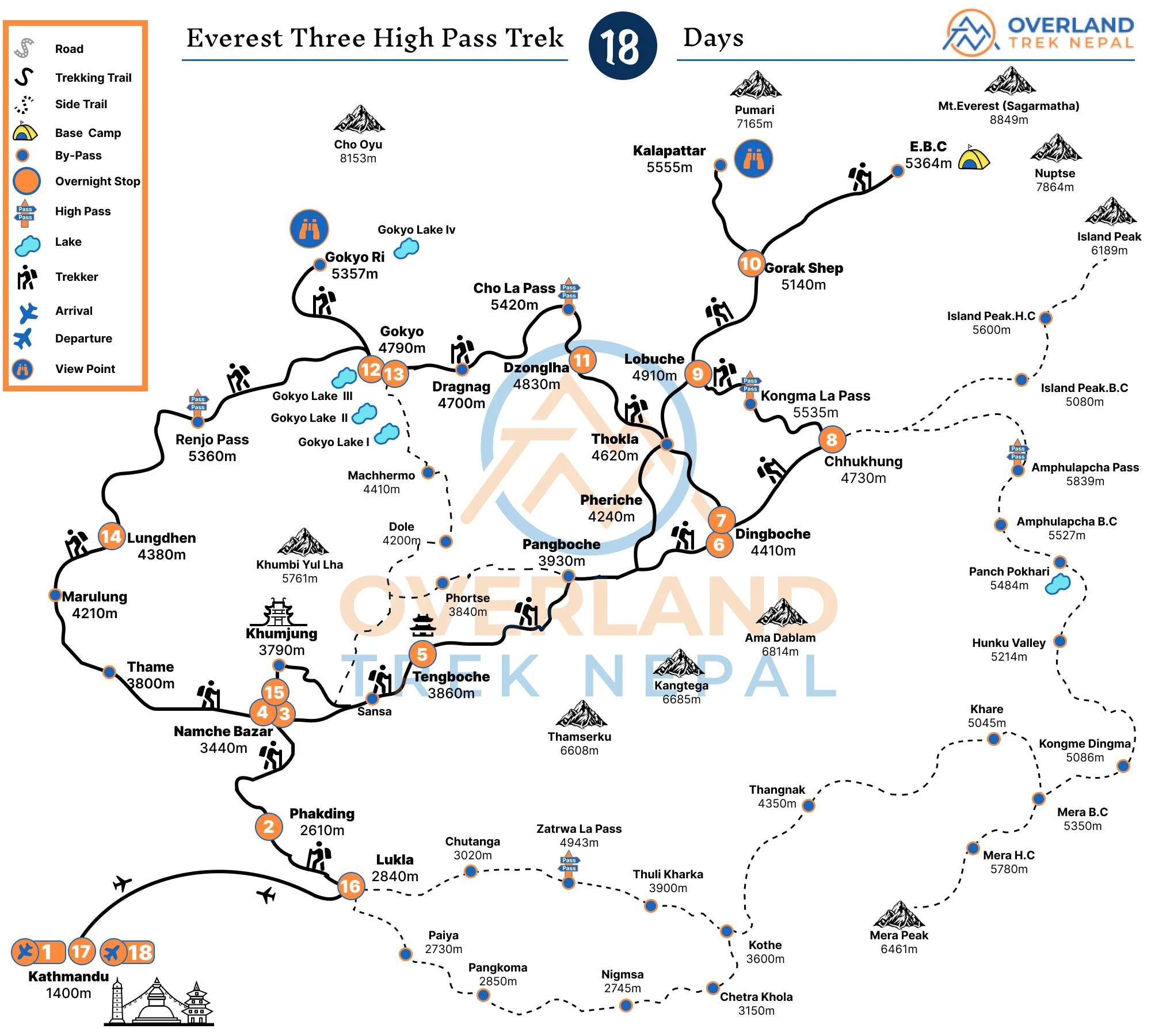
Key Highlights – Everest Three High Passes Trek 18 Days
- Cross Three Iconic High Passes – Challenge Kongma La (5,535 m), Cho La (5,420 m), and Renjo La (5,360 m) on an unforgettable Himalayan adventure.
- Visit Everest Base Camp (5,364 m) – Stand at the legendary base camp of the world's highest mountain.
- Sunrise from Kala Patthar (5,545 m) – Enjoy breathtaking sunrise views of Mount Everest and surrounding Himalayan peaks.
- Explore the Beautiful Gokyo Lakes – Discover the stunning turquoise glacial lakes in the heart of the Everest region.
- Hike to Gokyo Ri (5,357 m) – Experience panoramic views of Everest, Lhotse, Makalu, and Cho Oyu.
- Cross the Spectacular Cho La Pass – Trek across dramatic high-altitude terrain surrounded by glaciers and snow-covered mountains.
- Discover Authentic Sherpa Culture – Explore traditional mountain villages, Buddhist monasteries, and the warm hospitality of local communities.
- Walk Through the Khumbu Valley – Experience beautiful forests, suspension bridges, alpine landscapes, and traditional Himalayan settlements.
- Complete the Ultimate Everest Circuit – Explore remote trails beyond the standard Everest Base Camp Trek for a more challenging and rewarding experience.
- Enjoy an Unforgettable 18-Day Himalayan Adventure – Combine high mountain passes, legendary viewpoints, glacial lakes, and incredible mountain scenery with Overland Trek Nepal.
Everest Three High Passes Trek – 18 Days Everest Adventure Overview
The Everest Three High Passes Trek is an 18-day high-altitude adventure in Nepal that crosses three Himalayan passes: Kongma La (5,535 m), Cho La (5,420 m), and Renjo La (approximately 5,360 m).
The route combines Everest Base Camp (5,364 m), Kala Patthar (up to 5,644 m), and the beautiful Gokyo Lakes in one challenging circuit.
Starting and ending in Kathmandu, the trek takes you through remote Sherpa villages, mountain valleys, glaciers, and dramatic landscapes. It is best suited to experienced trekkers with excellent fitness.
Imagine standing above 5,000 meters, that too, 3 High Passes, surrounded by the highest mountains on Earth, with nothing but snowy peaks, mountain wind, and prayer flags around you.
That is what makes the Everest Three High Passes Trek special.
Unlike the classic Everest Base Camp Trek, this adventure takes you beyond the popular trail into three remarkable Himalayan valleys. You will cross challenging mountain passes, explore turquoise glacial lakes, and experience the remote beauty of the Khumbu region.
But this is not an easy trek. Long hiking days, freezing temperatures, steep rocky trails, and high altitude demand proper preparation.
Whether you are traveling solo, with friends, or as a private group, our team can help you prepare for an unforgettable Everest adventure in 2027.
Ready to explore the three highest trekking passes of Everest? Contact us via email or WhatsApp us at +977984192070
What Is the Everest Three High Passes Trek?
The Everest Three High Passes Trek is a challenging circuit in Nepal's Everest region that crosses Kongma La, Cho La, and Renjo La.
It also includes Everest Base Camp, Kala Patthar, and Gokyo Lakes. The Everest Three Passes trek typically requires 18–21 days or longer, depending on acclimatization and travel arrangements, and is recommended for experienced hikers.
Is the Everest Three High Passes Trek Worth It?
If you are an experienced trekker looking for a challenging adventure in Nepal, the Everest Three High Passes Trek is one of the most rewarding routes you can consider.
It combines the legendary Everest Base Camp trail with three challenging Himalayan passes, turquoise Gokyo Lakes, remote mountain settlements, and unforgettable views of the world's highest peaks.
But its greatest reward goes beyond the scenery.
The journey demands preparation, patience, determination, and respect for the mountains.
Every ascent, every cold morning, and every difficult crossing becomes part of the experience.
At Overland Trek Nepal, we want you to enjoy the adventure while making responsible decisions about altitude, weather, and route conditions.
Why Choose the Everest Three High Passes Trek?
The Everest Three High Passes Trek is ideal for trekkers who want more than a standard Everest Base Camp journey. Instead of following the same main trail for most of the trip, you explore different valleys connected by demanding mountain passes.
Every section offers something different. One morning, you may be walking beside a peaceful glacial lake. The next day, you could be climbing toward a high pass surrounded by towering Himalayan peaks.
Here are the main reasons experienced trekkers choose this adventure.
1. Cross Three Famous Himalayan Passes
The trek crosses Kongma La, Cho La, and Renjo La, all above 5,300 meters.
Each pass brings a different challenge, from rocky ascents and steep descents to potentially icy surfaces and exposed high-altitude terrain.
Crossing all three is a major achievement for trekking enthusiasts.
2. Visit Everest Base Camp and Kala Patthar
You do not have to choose between the classic Everest Base Camp experience and a more demanding Himalayan circuit.
This itinerary includes both.
You can visit Everest Base Camp, walk beside the Khumbu Glacier, and climb Kala Patthar for remarkable views of Mount Everest and neighboring peaks.
3. Explore the Beautiful Gokyo Lakes
Gokyo Valley is one of the scenic highlights of the Everest region.
Its turquoise lakes, vast glaciers, and mountain panoramas provide a different atmosphere from the busier Everest Base Camp route.
For many experienced trekkers, Gokyo becomes a favorite part of the entire journey.
4. Experience Remote Sherpa Villages
The trail passes through traditional settlements, including Namche Bazaar, Dingboche, Chhukung, Dzongla, Gokyo, Lungden, and Thame.
These villages offer opportunities to learn about local lifestyles, Buddhist traditions, mountain farming, and the Sherpa community's connection with the Himalayas.
5. Complete a Challenging Himalayan Circuit
Crossing three high passes requires endurance, patience, and careful decision-making.
The satisfaction comes not only from reaching the passes but also from completing the entire journey safely.
For trekkers who have already completed long-distance mountain hikes, the Everest Three Passes route is a natural next challenge.
What Are the Three High Passes of Everest?
The three high passes are Kongma La, Cho La, and Renjo La. All three connect different valleys within the Everest region. Although they are accessible as trekking routes in suitable conditions, their altitude, terrain, and unpredictable weather make them demanding crossings rather than ordinary hiking trails.
|
High pass |
Approximate elevation |
Main route connection |
Key challenge |
Main attraction |
|
Kongma La |
5,535 m |
Chhukung to Lobuche |
Steep, rocky terrain and glacier-moraine crossing |
Views of the Imja Valley and surrounding peaks |
|
Cho La |
5,420 m |
Dzongla to the Gokyo side |
Ice, snow, rocks, and steep sections |
Dramatic mountains and glacier scenery |
|
Renjo La |
5,360 m |
Gokyo to Lungden |
Long ascent and descent at high altitude |
Gokyo Lakes and Everest panoramas |
Kongma La Pass – The Highest of the Three Passes
Kongma La is generally considered the highest pass on the standard Everest Three Passes circuit. Located at approximately 5,535 meters, it connects the Chhukung Valley with the Lobuche area.
The crossing usually begins early in the morning because it involves a long and physically demanding day.
As you climb above Chhukung, the landscape becomes increasingly rocky and barren. Trails can be difficult to identify after snowfall, and some sections require careful movement over loose stones.
After reaching the pass, the descent toward Lobuche includes demanding moraine terrain and a crossing near the Khumbu Glacier.
Cho La Pass – The Icy Adventure Between Everest and Gokyo
Cho La Pass, approximately 5,420 meters high, connects the Everest Base Camp side of the Khumbu with the Gokyo Valley.
It is one of the most technically demanding sections of the Everest Three High Passes Trek.
The journey from Dzongla features rocky slopes and steep climbing. Depending on seasonal conditions, trekkers may encounter snow-covered rocks, frozen surfaces, and a glacier section.
Microspikes or crampons may be necessary when ice is present, and appropriate equipment should be chosen based on current conditions.
The descent leads toward the Gokyo side of the region, usually via Thagnak and the Ngozumpa Glacier area.
This crossing requires concentration, especially when snow or ice makes the trail slippery.
Local trekking tip: Cho La conditions can change quickly. Your guide will check recent crossing reports and choose the safest approach. A postponed or cancelled pass crossing is better than taking an unnecessary risk.
Renjo La Pass – Spectacular Views of Everest and Gokyo Lakes
Renjo La, approximately 5,360 meters high, is famous for its sweeping views over the Gokyo Lakes and the surrounding Himalayan mountains.
When approached from Gokyo, the route climbs steadily toward the pass before descending into the quieter Bhote Koshi Valley.
On a clear day, the panorama can include Everest, Lhotse, Makalu, and Cho Oyu. The deep-blue water of the lakes below creates an unforgettable mountain scene.
Although Renjo La is sometimes considered less technical than Cho La, it remains a strenuous high-altitude crossing. The descent to Lungden can be long and tiring, especially after several days of trekking above 4,000 meters.
Planning your Everest Three Passes Trek for 2027? Contact Overland Trek Nepal for a written quotation based on your preferred month, group size, and travel requirements.