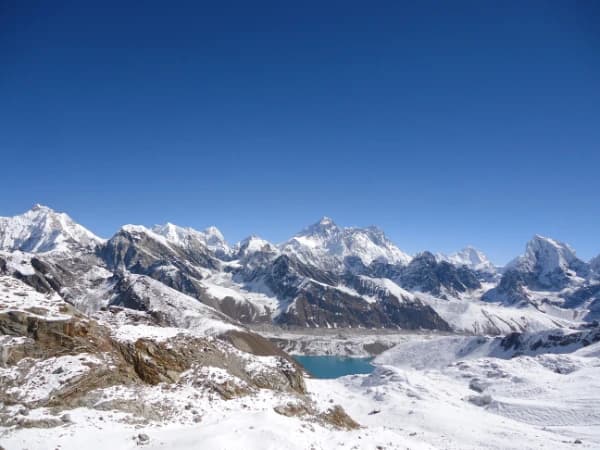
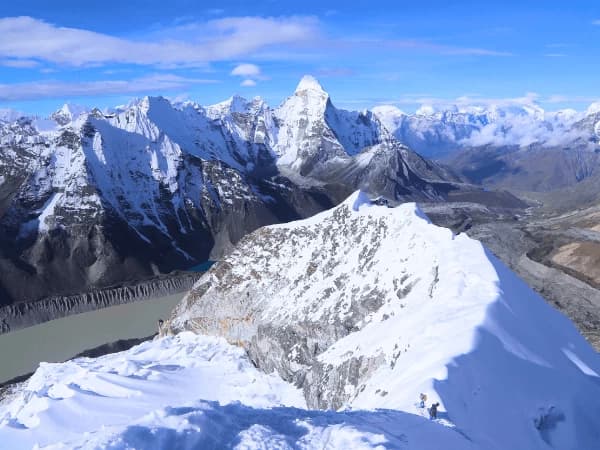
Mera Peak climbing is a high-altitude mountaineering expedition to the summit of Mera Peak (6,476 meters / 21,247 feet) in Nepal's Khumbu region, the highest permitted trekking peak in Nepal. Classified as a trekking peak by the Nepal Mountaineering Association (NMA), Mera Peak has three summits: Mera North (6,476m), Mera Central (6,461m), and Mera South (6,065m), with Mera North as the highest point reached on the standard guided climb. The 17-day route travels through the remote Hinku Valley, passing Sherpa villages rarely visited by mainstream trekkers, before ascending via Mera La glacier and Mera High Camp (5,780m) to the summit. From the top, climbers see five of the world's 8,000m peaks simultaneously, Everest, Lhotse, Makalu, Cho Oyu, and Kanchenjunga, making it one of the most panoramic summits achievable by non-expert climbers anywhere on Earth.
Why Climb Mera Peak? Key Highlights
- The highest trekking peak in Nepal. At 6,476m, Mera Peak is the tallest mountain in Nepal that can be climbed with a standard NMA trekking permit, without an expedition-grade permit or technical mountaineering certification.
- Best panoramic summit in the Himalayas, the only trekking peak in Nepal from which you can see five 8,000m mountains at once: Everest (8,849m), Lhotse (8,516m), Makalu (8,463m), Cho Oyu (8,188m), and Kanchenjunga (8,586m).
- Ideal first 6,000m summit, Mera Peak is widely regarded as the most accessible 6,000m peak in Nepal. The final summit push involves glacier walking and moderate snow slopes, no rock climbing, no vertical ice, and no fixed ropes required in most conditions.
- Off-the-beaten-path route, unlike the crowded Everest Base Camp trail, the Mera Peak approach through the Hinku Valley is remote, quiet, and culturally immersive, passing Rai and Sherpa villages rarely visited by foreign trekkers.
- Autumn 2026 season: September 15 – November 20, Post-monsoon skies clear fast, delivering crystal visibility and stable summit windows throughout October.
- Springtime wildflowers and Autumn golden valleys, both seasons offer spectacular scenery: spring brings rhododendron forests in full bloom, autumn delivers golden hillsides and crisp blue skies.
What is Mera Peak? Mountain Facts
|
Fact |
Detail |
|
Highest Summit (Mera North) |
6,476 m / 21,247 ft |
|
Mera Central |
6,461 m / 21,198 ft |
|
Mera South |
6,065 m / 19,898 ft |
|
Classification |
Trekking Peak — Nepal Mountaineering Association (NMA) |
|
Location |
Hinku Valley, Solukhumbu District, Khumbu Region, Nepal |
|
Range |
Mahalangur Himalaya |
|
First Ascent |
Jimmy Roberts, 1953 |
|
Nearest major peak |
Makalu (8,463m) |
|
Permit type |
NMA Trekking Peak Permit |
|
Best season |
Spring (Mar–May) & Autumn (Sep–Nov) |
|
Typical duration |
17–18 days |
|
Summit success rate |
~85–90% with a licensed agency and proper acclimatization |
|
Technical difficulty |
Low–Moderate (non-technical glacier walk) |
Mera Peak Climbing Cost for 2026 and 2027
The total Mera Peak climbing cost depends on group size, season, and service level. Here is a complete, transparent breakdown:
Overland Trek Nepal Package Prices
|
Group Size |
Price Per Person |
|
Solo (1 person) |
USD 2,749 |
|
2–3 persons |
USD 2,549 |
|
4–7 persons |
USD 2,349 |
|
8–12 persons |
USD 2,049 |
Mera Peak Climbing Price, What's Included
Included in the package: Round-trip domestic flights (Kathmandu/Ramechhap–Lukla), all meals during the trek (breakfast, lunch, dinner), teahouse accommodation throughout, 3-star hotel in Kathmandu (2 nights), experienced government-licensed climbing guide, porters (1 per 2 climbers, 20kg max), tent camp at Mera High Camp, all camping equipment, climbing ropes, ice screws, harness, all NMA and national park permits, farewell dinner, achievement certificate, company T-shirt, duffel bag, trekking poles, Nepal SIM card, and 1-hour post-trek massage.
Not included: International airfare, Nepal visa fee (~USD 50 for 30 days), personal travel and evacuation insurance (mandatory above 6,000m), personal climbing equipment (crampons, ice axe, boots), tips for guides and porters, personal expenses (WiFi, hot shower, charging, bottled water, alcohol).
Mera Peak Climbing Cost for Nepali Citizens
Nepali nationals pay significantly lower NMA permit fees — the Mera Peak climbing permit for Nepali citizens costs NPR 1,000–3,500 depending on season, compared to USD 125–250 for foreign nationals. Nepali citizens should contact us directly for a custom package price.
Government Permit Fees (2026)
|
Permit |
Spring (Mar–May) |
Autumn (Sep–Nov) |
Winter/Summer |
|
USD 250 |
USD 125 |
USD 75 |
|
|
USD 25 |
USD 25 |
USD 25 |
|
|
USD 20 |
USD 20 |
USD 20 |
|
|
USD 20 |
USD 20 |
USD 20 |
|
|
USD 20 |
USD 20 |
USD 20 |
All permit fees are fully included in Overland Trek Nepal's package. No hidden costs.
Best Time to Climb Mera Peak — Season Guide 2026 & 2027
The Mera Peak climbing season has two ideal windows per year. Choosing the right time is the single biggest factor in your summit success.
Autumn Season (September–November) — Best for 2026
The autumn Mera Peak climbing season runs from approximately September 15 to November 20. This is the most popular and reliable season:
- September: Trails are lush after the monsoon, and skies clear progressively. Slightly busier in early weeks; temperatures at High Camp average 5°C to +5°C by day.
- October: Peak climbing conditions. Clear blue skies, stable summit windows, minimal precipitation. Most climbers target the second and third weeks of October for summit attempts.
- November: Excellent visibility and fewer crowds. Colder nights at High Camp (–15°C to –20°C). Teahouse services remain fully open through mid-November.
Book autumn 2026 at least 3–4 months in advance. October departures fill up by July.
Spring Season (March–May) — Alternative for 2026 & 2027
Spring is the second-best Mera Peak climbing season, offering warmer temperatures and dramatic rhododendron-covered trails:
- March: Cool and clear. Fewer crowds. Some high-altitude snowfall is possible.
- April: Ideal balance of warmth and clarity. Peak booking season.
- May: Warmer at lower elevations; busier trails and flight congestion at Lukla/Ramechhap. Pre-monsoon clouds build in late May.
Seasons to Avoid
- Monsoon (June–August): Heavy rainfall, flooded Hinku Valley trails, poor visibility, significantly elevated avalanche and landslide risk in the Mera La approach.
- Winter (December–February): Extreme cold (–30°C at High Camp), teahouses partially closed above Kothe, high risk of frostbite and severe AMS.
How Difficult is Mera Peak Climbing?
Mera Peak is the least technically demanding 6,000m peak in Nepal, and one of the most accessible high summits in the world. Here is what to expect at each stage:
Trekking Phase — Days 1–9 (Lukla to Khare): The Hinku Valley approach is a remote, moderately strenuous multi-day trek. Daily walking of 4–8 hours on well-used trails through forest and high alpine terrain. No technical equipment required. The biggest challenge is altitude gain; you rise from 2,800m at Paiya to 5,045m at Khare over 7 days.
Pre-Climb Training — Day 9 (Khare): Your Overland Trek Nepal guide conducts a full acclimatization day at Khare with 2–3 hours of practical training: crampon use, ice axe technique, rope management, and emergency protocols. This is when you adapt to the altitude before the summit push.
High Camp Approach — Day 10: A 5–6 hour ascent from Khare (5,045m) to Mera High Camp (5,780m) across Mera La glacier. Crampons are used on the glacier section. Moderate difficulty.
Summit Day — Day 11:
- Start time: 2:00–3:00 AM from High Camp
- Terrain: Snowfields and a broad glacier approach, then a moderately steep final snow slope to the summit dome
Mera Peak and Everest Base Camp Trek, Combined Option
For climbers who want both iconic experiences, Overland Trek Nepal offers a Mera Peak + Everest Base Camp combined expedition. This requires a minimum of 22–24 days and involves linking the Hinku Valley (Mera route) with the Khumbu Valley (EBC route) via the Amphu Lapcha Pass or by returning to Lukla and retracing from Namche.
Alternatively, the most popular combination is Mera Peak + Island Peak Climbing in 22 days, completing both the highest and most technical trekking peaks in the Everest region in a single trip. This combination is ideal for climbers who want maximum high-altitude experience without booking two separate expeditions.
Contact Overland Trek Nepal to customize your Mera + EBC or Mera + Island Peak itinerary.
- No fixed ropes required in standard conditions (unlike Lobuche or Island Peak)
- Round trip: 7–9 hours from High Camp
- Descent: Same route back; return to Khare by late afternoon
The key challenge is not technical terrain; it is altitude. At 6,476m, you are operating at approximately 46% of sea-level oxygen. Physical fitness and acclimatization are far more important than climbing skills.