Quick Comparison: Mera Peak vs Lobuche Peak
|
Feature
|
Mera Peak
|
Lobuche East Peak
|
|
Summit Altitude
|
6,476 m (21,247 ft)
|
6,119 m (20,075 ft)
|
|
Technical Difficulty
|
Moderate (physical challenge)
|
High (technical climbing required)
|
|
Distance from Lukla
|
125–130 km
|
70–80 km
|
|
Duration
|
12–15 days
|
15 days
|
|
Best Season
|
Spring & Autumn
|
Spring & Autumn
|
|
Starting Price (2026)
|
USD $2,699/person
|
USD $2,699/person
|
|
Combined Package
|
USD $5,400/person
|
—
|
|
Permit Required
|
NMA + Makalu Barun NP
|
NMA + Sagarmatha NP
|
|
Altitude Sickness Risk
|
High (the highest trekking peak)
|
High (technical terrain)
|
What Is Mera Peak Climbing?
Mera Peak (6,476 m) is the highest trekking peak in Nepal and sits in the Mahalangur Himalayan range within the Everest Region. Unlike many high-altitude peaks, Mera does not demand advanced rock or ice climbing techniques, making it a popular first 6,000-meter summit for well-prepared trekkers.
The peak has three summits: Mera North (6,476 m), Mera Central (6,461 m), and Mera South (6,065 m). The climbing objective is Mera North. From the summit, climbers see an extraordinary panorama of five of the world's highest mountains: Everest (8,849 m), Lhotse (8,516 m), Makalu (8,485 m), Cho Oyu (8,188 m), and Kanchenjunga (8,586 m).
Mera Peak is best suited for: Trekkers with strong physical fitness; no advanced technical climbing experience required, but glacier travel skills are helpful.
What Is Lobuche Peak Climbing?
Lobuche East Peak (6,119 m) stands near the iconic Khumbu Glacier on the classic Everest Base Camp trail. It has two summits: Lobuche East (6,119 m), a designated trekking peak, and Lobuche West (6,145 m), which is an advanced expedition requiring elite technical skills.
Lobuche East Peak climbing involves steep, icy ridges, mixed rock and snow sections, and a demanding final push to the summit. The proximity to Everest Base Camp makes it popular as a combined trek-and-climb itinerary, and the views from the top- Pumori, Nuptse, the Khumbu Icefall, and Everest's southwest face- are among the most dramatic in the Nepal Himalayas.
Lobuche East is best suited for: Climbers with prior mountaineering experience, basic to intermediate rope skills, and familiarity with crampons and ice axes.
Mera Peak vs Lobuche Peak: Technical Difficulty Compared
Lobuche East Peak climbing is the more technical of the two. The summit ridge involves a steep ice and mixed rock face that requires competent use of fixed ropes, ice axes, and crampons. Climbers must be comfortable with exposure and vertical gain on technical terrain.
Mera Peak is more physically demanding than technically demanding. The route involves long glacier walks, strenuous elevation gain, and significant altitude, but the climbing itself does not require advanced rope techniques. That said, climbers must know how to use crampons, an ice axe, and a harness, and they must be prepared for glacial terrain.
Rule of thumb: If you have done multi-day treks above 5,000 m but have limited climbing experience, start with Mera Peak. If you have basic mountaineering training (rope work, crampon use) and want a technical challenge, Lobuche East is the right next step.
Lobuche East Peak Climbing: Route, Itinerary & Details
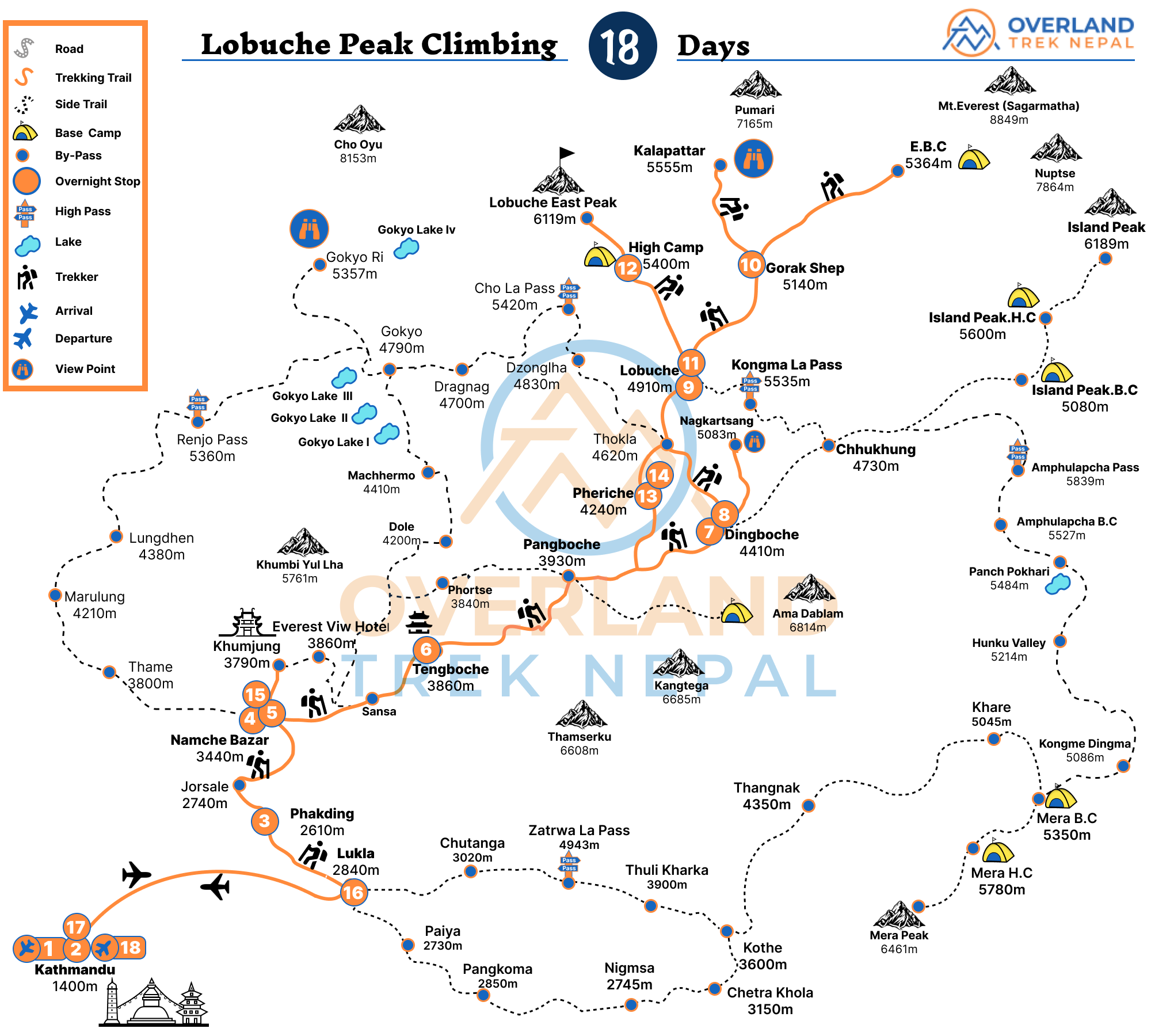
Day 01 — Arrival in Kathmandu (1,400m / 4,592ft)
Day 02 — Rest Day in Kathmandu for Trek Preparation
Day 03 — Kathmandu/Ramechhap to Lukla (2,840m / 9,316ft) & Trek to Phakding (2,610m / 8,561ft)
Day 04 — Phakding to Namche Bazaar (3,440m / 11,284ft)
Day 05 — Rest & Acclimatization in Namche Bazaar (3,440m / 11,284ft)
Day 06 — Namche Bazaar to Tengboche (3,860m / 12,661ft)
Day 07 — Trek from Tengboche to Dingboche (4,410m / 14,465ft)
Day 08 — Acclimatization in Dingboche (4,410m / 14,465ft)
Day 09 — Dingboche to Lobuche (4,910m / 16,105ft)
Day 10 — Lobuche to Gorak Shep (5,140m) & Everest Base Camp Hike (5,364m)
Day 11 — Hike to Kala Patthar (5,550m / 18,204ft) & Back to Lobuche (4,910m / 16,105ft)
Day 12 — Climb to High Camp (5,400m / 17,712ft) & Pre-Climb Training
Day 13 — Summit Lobuche East (6,119m / 20,070ft) & Descend to Pheriche (4,240m / 13,911ft) via Thukla Pass
Day 14 — Contingency Day
Day 15 — Trek to Namche Bazaar (3,440m / 11,286ft)
Day 16 — Namche Bazaar to Lukla (2,840m / 9,316ft)
Day 17 — Lukla to Ramechhap/Kathmandu (1,400m / 4,592ft) — fly
Day 18 — Final Departure
Lobuche Peak Climbing Cost (2026)
Lobuche East Peak climbing starts at USD $2,699 per person with Overland Trek Nepal. The price includes a certified climbing guide, permits (Nepal Mountaineering Association permit, Sagarmatha National Park, Khumbu Municipality), accommodation, meals on trek, and climbing equipment support.
Three Peaks Climbing: Pokalde, Island Peak, and Lobuche East
For experienced climbers seeking a greater challenge, the Three Peaks Climbing itinerary, combining Pokalde Peak, Island Peak (Imja Tse), and Lobuche East, is a premier Himalayan mountaineering expedition. This combines three distinct 6,000-meter summits, each with its own technical character, in one continuous journey through the Khumbu. Contact Overland Trek Nepal for the customized itinerary and pricing.
Mera Peak Climbing: Route, Itinerary & Details
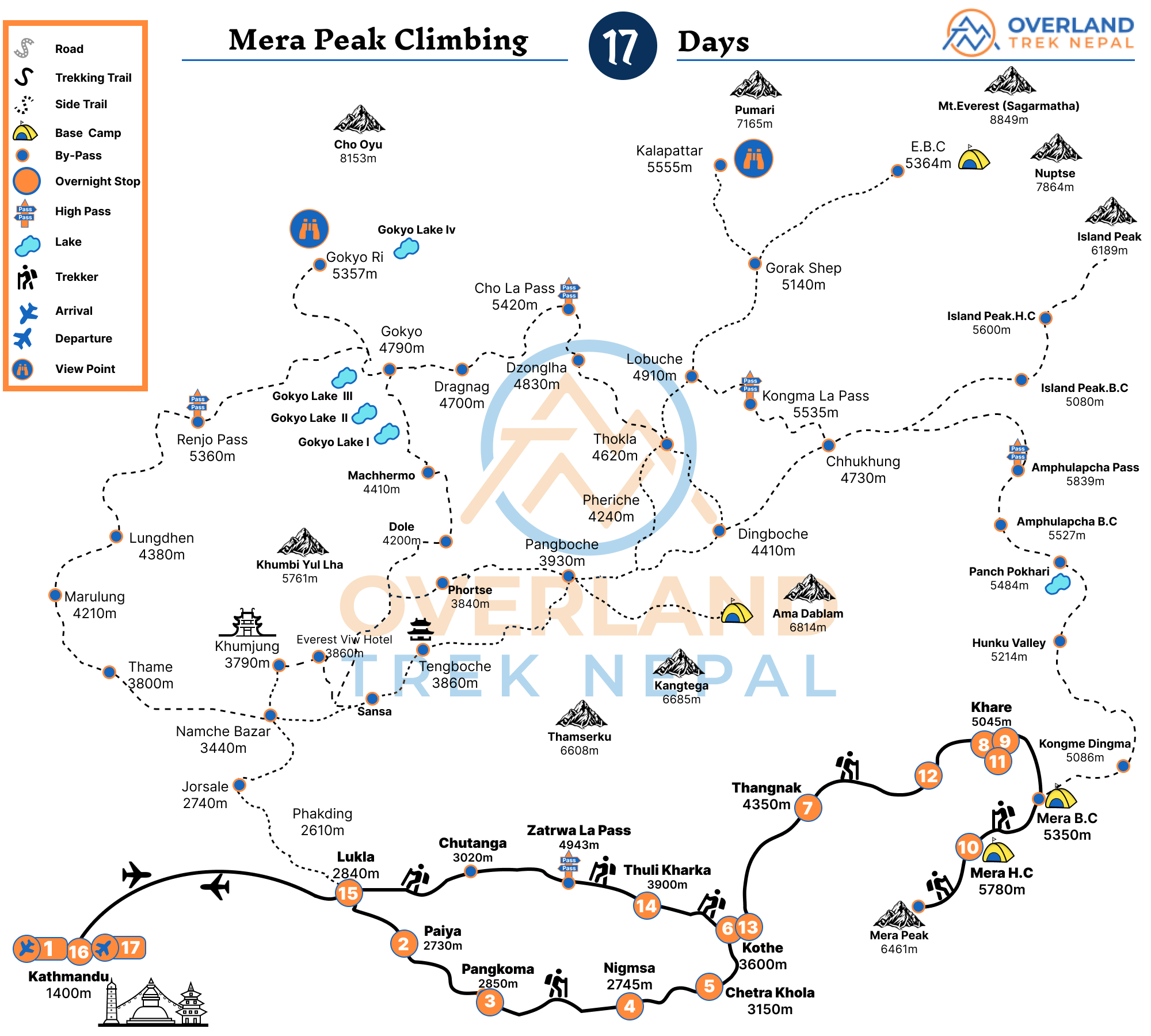
Day 01 — Arrival in Kathmandu (1,400m / 4,429ft) & Trip Preparation
Day 02 — Fly to Lukla, Trek to Paiya (Chutok) (2,800m / 9,187ft) — 5–6 hrs
Day 03 — Paiya to Panggom (2,846m / 9,338ft) — 5–6 hrs
Day 04 — Panggom to Ningsow (2,863m / 9,394ft) — 4–5 hrs
Day 05 — Ningsow to Chhatra Khola (2,800m / 9,187ft) — 7–8 hrs
Day 06 — Chhatra Khola to Kothe (3,691m / 12,110ft) — 6–7 hrs
Day 07 — Kothe to Thaknak (4,358m / 14,299ft) — 3–4 hrs
Day 08 — Thaknak to Khare (5,045m / 16,553ft) — 2–3 hrs
Day 09 — Acclimatization & Pre-Climb Training in Khare (5,045m / 16,553ft)
Day 10 — Khare to Mera High Camp (5,780m / 18,964ft) — 5–6 hrs
Day 11 — Mera High Camp to Summit (6,461m / 21,199ft) & Back to Khare
Day 12 — Reserve / Contingency Day
Day 13 — Khare to Kothe (3,691m / 12,110ft) — 5–6 hrs
Day 14 — Kothe to Thuli Kharka (4,300m / 14,108ft) — 6–7 hrs
Day 15 — Thuli Kharka to Lukla via Zatrwa La Pass (4,600m / 15,093ft) — 7–8 hrs
Day 16 — Fly to Ramechhap/Kathmandu (1,400m / 4,429ft)
Day 17 — Final Departure
Mera Peak Climbing Cost (2026)
Mera Peak climbing starts at USD $2,749 per person with Overland Trek Nepal. Included: certified climbing guide, all required permits (NMA, Sagarmatha National Park, Makalu Barun National Park), trek accommodation, meals, and gear support.
Best Climbing Season for Mera Peak and Lobuche Peak
The two best climbing seasons for both Mera and Lobuche Peak are:
Spring (March–May): The pre-monsoon window is the most popular season for peak climbing in Nepal. Temperatures are warming, skies are clear, and conditions on the glaciers are generally stable. May is the peak summit month across the Himalayas.
Autumn (September–November): The post-monsoon season brings clear, crisp air and exceptional visibility after the monsoon washes away dust and haze. October and November are considered ideal months for Lobuche East peak climbing and Mera Peak summit attempts.
Avoid: The monsoon season (June–August) brings heavy rain, leeches on lower trails, and unstable snow on the upper mountain. Winter (December–February) is possible for experienced climbers but brings extreme cold and high winds.
Required Permits for Mera Peak and Lobuche Peak (2026)
Lobuche East Climbing Permits
Mera Peak Climbing Permits
All permits must be arranged through a registered Nepal Mountaineering Association member agency. Overland Trek Nepal is a licensed NMA member agency and handles all permit logistics on your behalf. Climbers must provide a valid passport, Nepal visa, travel insurance document, and medical certificate.
Altitude Sickness Risk on Mera Peak and Lobuche Peak
Both peaks exceed 6,000 meters, a threshold where Acute Mountain Sickness (AMS), High-Altitude Pulmonary Edema (HAPE), and High-Altitude Cerebral Edema (HACE) are genuine risks. Altitude sickness does not discriminate by fitness level or prior trekking experience.
Common AMS Symptoms to Watch For
- Persistent headache not relieved by hydration
- Nausea or vomiting
- Dizziness or loss of coordination
- Shortness of breath at rest
- Extreme fatigue or weakness
- Sleep disturbances
How to Prevent Altitude Sickness on Your Climb
- Acclimatize properly, include at least two dedicated rest days in your itinerary above 4,000 m.
- Ascend slowly, gain no more than 300–500 m of sleeping altitude per day above 3,500 m.
- Stay hydrated, drink 3–4 liters of water daily; avoid alcohol.
- Eat nutritious meals, high-carbohydrate foods help with energy and acclimatization.
- Consult your doctor about Diamox (Acetazolamide), commonly prescribed as a preventative measure for high-altitude climbs.
- Descend immediately if symptoms worsen; never ascend with active AMS symptoms.
- Know the evacuation plan — helicopter rescue from both Mera and Lobuche is available and covered by most comprehensive travel insurance policies.
Preparation and Training for Peak Climbing in Nepal
Physical Training (Begin 3–6 Months Before)
- Cardio base: Running, cycling, or swimming 4–5 days per week
- Leg strength: Squats, lunges, step-ups, and weighted stair climbs
- High-altitude simulation: High-altitude treks like the Everest Base Camp Trek, the Annapurna Circuit, or the Langtang Valley Trek
- Backpack training: Complete training hikes with a 10–15 kg loaded pack
Technical Skills for Lobuche East
- Crampon technique on ice and mixed terrain
- Ice axe self-arrest
- Fixed rope ascending (jumar use)
- Basic rope team travels on glaciers
Gear Checklist
- Mountaineering boots (double-layered, rated to -30°C)
- Crampons (12-point, compatible with your boots)
- Ice axe
- Sit harness + locking carabiners
- Helmet
- Down suit or insulated layers
- High-altitude sleeping bag (rated -20°C or colder)
- Trekking poles
- Sunglasses and goggles (100% UV protection)
- Sunscreen SPF 50+
Frequently Asked Questions
Is Mera Peak suitable for beginners?
Yes, Mera Peak is considered Nepal's most accessible 6,000-meter peak. It does not require technical rock or ice climbing skills, but climbers must be physically fit and comfortable on glacier terrain. Prior experience above 5,000 m is an advantage.
Is Lobuche East harder than Mera Peak?
Yes, Lobuche East is technically more demanding, with exposed ridges, steep ice sections, and mixed terrain near the summit. Mera is physically harder but technically simpler.
Can I combine Mera Peak and Lobuche Peak in one trip?
Yes, Overland Trek Nepal offers a combined Mera + Lobuche Peak climbing package starting at USD $5,400 per person. This is an excellent option for climbers who want to maximize their Himalayan experience in a single expedition.
What is the success rate for Mera Peak and Lobuche Peak?
Success rates vary by season, weather, and individual preparation. With proper acclimatization and experienced guides, summit rates are high for both peaks. Overland Trek Nepal maintains one of the highest success rates in Nepal.
Do I need a climbing guide for Mera or Lobuche Peak?
Yes, a certified climbing guide is required by Nepal's mountaineering regulations, and it is essential for safety. Overland Trek Nepal provides both a lead guide and an assistant guide for all peak climbing expeditions.
What documents do I need to submit?
Valid passport, Nepal visa, travel and rescue insurance, medical fitness certificate, passport photos, and payment receipt including the waste management deposit fee.
How far in advance should I book?
Book at least 3–6 months ahead for the spring season (March–May) and 2–4 months ahead for autumn (September–November). Permits and logistics require lead time.
Is Lobuche East close to Everest Base Camp?
Yes, the Lobuche East climbing route passes through Lobuche village and Gorak Shep, and many Lobuche itineraries include a side visit to Everest Base Camp (5,364 m) — making it a highly rewarding combined experience.
Why Choose Overland Trek Nepal for Peak Climbing
Overland Trek Nepal is a government-licensed trekking and mountaineering company and a registered member of the Nepal Mountaineering Association (NMA). Key reasons climbers choose us:
- Dedicated safety protocols with full logistics support from Kathmandu to the summit
- Lead climbing guide + assistant guide on all peak expeditions
- Oxygen bottles and first aid kits are carried by the climbing team throughout
- Real-time communication and climber monitoring throughout the journey
- Peak Climbing Achievement Certificate upon successful summit
- Complimentary duffel bag, T-shirt, and cap from Overland Trek Nepal
- Transparent pricing with no hidden fees
📞 WhatsApp: +977 9851138871 📧 Email: [email protected]


.webp&w=1200&q=75&dpl=dpl_EUd5Wwb28cTzwN6qQNwTKfhuRohE)
.webp&w=1200&q=75&dpl=dpl_EUd5Wwb28cTzwN6qQNwTKfhuRohE)