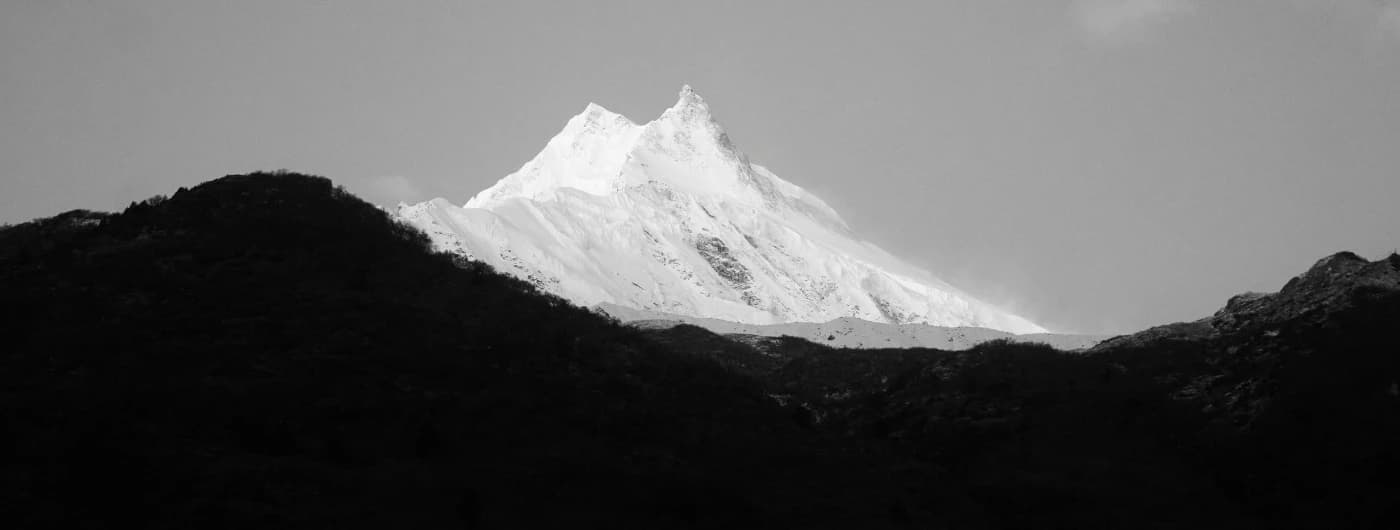
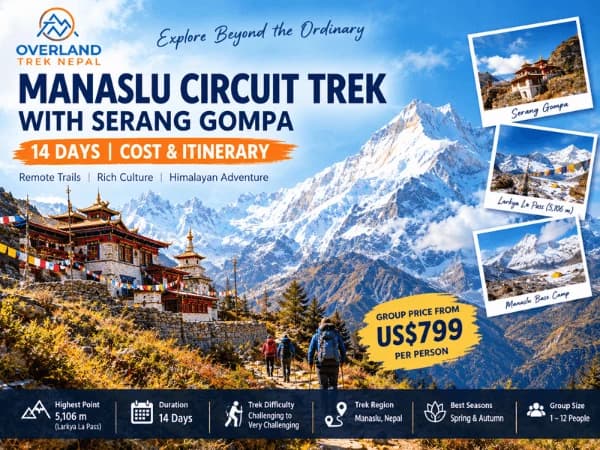
Located in the remote Manaslu Region of north-central Nepal, this adventure takes you beneath the towering 8,163-meter Mount Manaslu, which is Nepal's 8th highest peak and the world's 8th tallest mountain
Manaslu Base Camp Hike Cost 2026-2027: Distance, Difficulty & Complete Budget Guide
Quick Answer: Manaslu Base Camp Hike Essentials
Manaslu Base Camp hike costs $1,299–$1,799 per person for a complete 17-day guided trek in 2026-2027. The actual hike from Samagaun village to base camp is 12-14 kilometers round trip, taking 7-9 hours, reaching an elevation of 4,800 meters. The trek requires moderate-to-hard fitness, demanding 4-6 months of preparation. Best season: Autumn (October) offers clear skies (85-95% visibility), the lowest permit costs ($175 vs spring's $350), and the highest success rate at 85-90%.
Key Facts At a Glance
- Total Trek Duration: 17 days (Kathmandu to Kathmandu)
- Base Camp Hike Distance: 12-14 km round trip from Samagaun
- Base Camp Hike Duration: 7-9 hours with rest breaks
- Samagaun Base Camp Hike Elevation Gain: 1,270 meters (3,530m → 4,800m)
- Highest Pass: Larkya La Pass at 5,160 meters
- Annual Visitors: Only 2,500-3,000 (vs 50,000+ on Everest)
- Difficulty Level: Moderate-to-Hard (4/5 stars)
- Success Rate: 85-90% (with proper training)
- Best Time: Autumn (September-November), especially October
- Cost Per Day: $76-$106 USD (all-inclusive)
- Training Required: 4-6 months minimum
- Official Permits Required: NMA (Nepal Mountaineering Association), Sagarmatha National Park, Manaslu Conservation Area, Khumbu Municipality
About The Manaslu Base Camp Hike
The Manaslu Base Camp hike is part of the larger Manaslu Circuit Trek, a complete 17-18 day loop that takes you through traditional Sherpa villages, Buddhist monasteries, and Tibetan-influenced settlements.
Starting from Soti Khola near the Gorkha District, the trail winds through lush rhododendron forests, past ancient suspension bridges, and through the stunning Budi Gandaki River gorge. Eventually, you reach Samagaun, the gateway village to Manaslu Base Camp.
From Samagaun, the challenging day hike takes you to base camp itself, perched at 4,800 meters with panoramic views of the Manaslu Himal, surrounding peaks, and glacial landscapes. After summiting the base camp, you continue on the circuit by crossing the legendary Larkya La Pass (5,160m), one of the Himalayas' most rewarding high mountain passes.
Why This Trek Stands Out:
Unlike point-and-return treks like Everest Base Camp or Annapurna Base Camp, the Manaslu Circuit offers a complete loop experience:
- Trek UP the remote Budi Gandaki Valley (Days 3-9)
- Summit Manaslu Base Camp for acclimatization (Day 10)
- Cross the dramatic Larkya La Pass (Day 13)
- Descend via a different route back to civilization (Days 14-16)
This creates a true circuit trek with diverse landscapes, varying ecosystems, and a rich Tibetan-influenced culture you won't find on more commercialized routes. According to the Nepal Tourism Board, the Manaslu region receives only 2,500-3,000 foreign trekkers annually, making it one of Nepal's least crowded major trekking destinations.
Manaslu Base Camp Hike: Distance, Time & Elevation
Samagaun to Manaslu Base Camp: Detailed Breakdown
- Starting Point Altitude: 3,530 meters (Samagaun village)
- Ending Point Altitude: 4,800 meters (Manaslu Base Camp)
- Total Elevation Gain: 1,270 meters (steep but achievable)
- Round-Trip Distance: 12-14 kilometers (varies with snow/conditions)
- Total Hiking Time: 7-9 hours (including rest breaks and altitude adjustments)
- Daily Elevation Gain Rate: ~150 meters per hour
Trail Type: Rocky sections, glacial terrain, steep climbs, possible snow patches (especially October-November)
Hour-by-Hour Timeline: What to Expect
- 5:30-6:00 AM — Wake & Breakfast at Samagaun Lodge Light breakfast of porridge, eggs, and hot tea/coffee. Final pack check. Elevation: 3,530m. Duration: 30 minutes.
- 6:30-8:30 AM — Trek Through Samagaun Village. Begin trek through the village past Buddhist prayer flags and local monasteries. Gradual initial climb. Well-defined stone paths. Breathing becomes slightly elevated. Elevation gain: 3,530m to 3,800m (270m gain). Duration: 2 hours.
- 8:30-10:00 AM — Steep Forest Climb: Ascend through juniper and rhododendron forests. The trail becomes noticeably steeper. The rest-step technique becomes necessary. Breathing increases significantly. You'll begin feeling altitude effects. Elevation gain: 3,800m to 4,300m (500m gain). Duration: 1.5 hours.
- 10:00-10:30 AM — Rest Break at High Altitude: Critical acclimatization break. Hydrate aggressively, eat energy snacks. Allow the body to adjust to the altitude. Monitor for headache or nausea. Elevation: 4,300m. Duration: 30 minutes.
- 10:30 AM-12:00 PM — Final Ascent to Base Camp: Steep final push. Rocky and snowy terrain. The glacier approach becomes visible. Mountain views expand dramatically. Excitement builds as you approach the summit. Elevation gain: 4,300m to 4,800m (500m gain). Duration: 1.5 hours.
- 12:00-1:00 PM — MANASLU BASE CAMP SUMMIT ⭐ THE MOMENT You've reached 4,800 meters! Take 360° panoramic photographs. Celebrate with fellow trekkers. Experience the achievement. Elevation: 4,800m. Duration: 1 hour.
- 1:00-3:00 PM — Descent to Samagaun Careful descent on scree and rocky terrain. Use trekking poles to reduce knee strain. Rapid altitude drop provides relief. Watch footing as fatigue increases. Elevation drop: 4,800m to 3,530m (1,270m descent). Duration: 2 hours.
- 3:30-4:00 PM — Return & Recovery Arrive back at Samagaun lodge. Change into dry clothes. Rest and prepare for a hot meal. Elevation: 3,530m. Duration: 30 minutes.
Total Active Hiking Time: 7-8 hours | Total Time with Rests & Descent: 9-10 hours
Manaslu Base Camp Hike Difficulty Level

Honest Difficulty Assessment
The Manaslu Base Camp hike is significantly more challenging than casual day hikes but less technical than mountaineering expeditions requiring ice climbing or rope work.
Hiking Experience Required: ⭐⭐⭐⭐ (4 out of 5 stars)
- Not suitable for trekking beginners
- Best for trekkers with 1-2 previous high-altitude treks completed
- Minimum requirement: Completed a trek to 3,500m+ elevation like the Everest Base Camp Trek or the Langtang Valley Trek
Fitness Level Needed: ⭐⭐⭐⭐ (4 out of 5 stars)
- Ability to hike 6-8 hours daily with 400-600m elevation gain
- Cardiovascular endurance essential (running/cycling 4-5x weekly for 4-6 months)
- Leg strength crucial for steep sections (squats, lunges, step-ups regularly)
- Core stability is required for balance on steep terrain at altitude
Altitude Challenge: ⭐⭐⭐⭐ (4 out of 5 stars)
- 4,800m elevation means approximately 50% of sea-level atmospheric oxygen
- Headache, nausea, and fatigue are common reactions
- Built-in acclimatization days (Days 9-10) reduce Acute Mountain Sickness (AMS) risk to 20-30%
- Sleep-low protocol (summit 4,800m, sleep at 3,530m) prevents serious AMS progression
- Success: Staying hydrated, eating regularly, and moving slowly all help your body adapt
Technical Difficulty: ⭐⭐ (2 out of 5 stars)
- NOT a technical climb, no ice climbing, ropes, or mountaineering skills required
- Non-technical high-altitude hiking is similar to the approach on Island Peak, but easier
- Basic balance and scrambling on steep rocky terrain (within beginner mountaineer capability)
- Crampons are used on snow sections (guide provides instruction and assistance)
Why This Hike Rates as "Hard"
- Continuous 1,270m Elevation Gain Climbing steep terrain all day is demanding
- Altitude Stress at 4,800m: Half the atmospheric oxygen forces body adaptation
- Loose Rocky Terrain: Treacherous footing when fatigued from high altitude
- Unpredictable Mountain Weather Conditions change rapidly on high slopes
- Isolation & Distance Emergency help is hours away if injury occurs
Who CAN Do This Hike?
- Experienced High-Altitude Trekkers BEST FIT. Requires 1+ high-altitude trek completion + good fitness. Success rate: 90%+.
- Fit Non-Trekkers (Athletes) Possible with a 4-6 month dedicated training program and experienced guide support. Success rate: 70-80%.
- Casual Day Hikers Not recommended. Too difficult and dangerous without altitude experience. Success rate: 40-50%.
- Complete Trekking Beginners : Absolutely NOT suitable. Start with the Annapurna Base Camp Trek (easier) or the Everest Base Camp Trek (moderate) first.
- Over 50 with Good Fitness. It depends entirely on individual fitness level, altitude experience, and a realistic assessment of your abilities.
Honest Assessment: If you've completed the Everest Base Camp Trek comfortably and enjoyed it, you CAN do the Manaslu Base Camp hike. If not, complete EBC first as a warm-up trek.
How To Prepare: Complete A 4-6 Month Training Plan
Month 1-2: Cardiovascular Foundation Building
Goal: Build aerobic base capacity, increase VO2 max, establish exercise habit
Weekly Training Schedule:
- Monday Running or cycling 30-45 minutes. Conversational pace (you can talk but not sing). Start at 3-4 km, progressively build to 5-6 km by the end of the month. Build one long run per week.
- Tuesday: Leg strength training 45 minutes. Squats: 3 sets x 15 reps (bodyweight or dumbbells). Lunges: 3 sets x 12 reps per leg. Step-ups with weight: 3 sets x 12 reps. Step-ups mimic trekking uphill perfectly.
- Wednesday Hiking with elevation 60-90 minutes. Find local hills with 300-500m elevation gain. Wear a light backpack (5-8 kg) to simulate trekking. This is your "adventure training."
- Thursday Cross-training 45 minutes. Swimming, cycling, rowing, or an elliptical machine. Steady pace, low-impact. Great for active recovery while maintaining cardio.
- Friday Rest or easy walk 20-30 minutes. Light stretching and yoga. Recovery is when your body adapts.
- Saturday Long hike 2-3 hours with 600m-1000m elevation gain. Weekend adventure time. Build to longer distances progressively. Explore local mountains.
- Sunday Complete rest day. Stretching and yoga only. Let your body recover fully.
Additional Strength Work (Daily/3x per week):
- Calf raises: 3 sets x 20 reps, 2-3x per week (essential for hiking downhill)
- Planks: 3 sets x 60 seconds daily (core strength at altitude is critical)
- Side planks: 3 sets x 45 seconds each side, daily
- Russian twists: 3 sets x 20 reps, 3x per week
- Leg raises: 3 sets x 15 reps, 3x per week
Success Metrics (End of Month 2):
- Run or cycle 5 km comfortably (consistent pace)
- Hike 1,000m elevation in 2 hours without exhaustion
- 50+ consecutive bodyweight squats with proper form
- Hold a 2-minute plank easily with good form
Month 3-4: High-Altitude Acclimatization Training
Goal: Expose body to altitude, practice full gear setup, test acclimatization response, identify any issues early
Primary Activity: Complete a 5-7 day high-altitude trek
Recommended Acclimatization Treks (Pick ONE):
- Langtang Valley Trek Reach Kyanjin Gompa (3,870m). 8-10 days total. Close to Kathmandu. Great warm-up.
- Short Manaslu Trek Reach Samdo (3,875m). 10 days. Actual Manaslu region familiarization.
- Gokyo Valley Trek Reach Gokyo Lake (4,790m). 14 days. Excellent high-altitude adaptation.
- Everest Base Camp Trek Reach Gorak Shep (5,364m). 12-14 days. Most popular, most crowded. Best preparation for Manaslu.
CRITICAL: Sleep multiple nights above 3,000m elevation to experience altitude effects firsthand. This is non-negotiable.
Gear Testing During This Phase:
- Rent a complete trekking kit from local Kathmandu shops (Shona's Alpine Rental, Himalayan Guides Gear, Sherpa Adventure Gear)
- Test boots with thick climbing socks for all-day comfort (break them in properly)
- Test sleeping bag at 3,500m+ altitude to verify warmth rating (you need -25°C rated minimum)
- Wear all layers together in cold conditions to verify compatibility
- Practice with a loaded pack carrying 15-20 kg for full days
- Test water filters, headlamp, and all equipment in real conditions
- Get comfortable with gear before the actual Manaslu trek
Strength Training Maintenance:
- Reduce cardio frequency but maintain intensity (still 2-3x per week)
- Continue leg strengthening 2-3x per week (maintain your gains)
- Focus on maintenance, not building new strength (let body recover at altitude)
- Your body adapts better to moderate activity at altitude
Success Metrics (End of Month 4):
- Complete a 5-7 day trek with overnight stays at 3,500m+ altitude
- Experience mild AMS symptoms and know how to handle them (this is learning!)
- All gear tested, fitted, approved, and proven in real conditions
- Comfortably hike 4-6 hours daily with a full 15kg backpack loaded
- Confidence in altitude hiking (fear decreases with experience)
Month 5-6: Manaslu-Specific Peak Preparation
Goal: Reach peak fitness, simulate exact Manaslu conditions, achieve final readiness, build mental confidence
Back-to-Back Trekking Simulation:
Complete 2-3 consecutive days of 6-8 hour hikes with 400-600m daily elevation gain (matches Manaslu itinerary exactly). Carry full loaded pack (same weight as the actual trek: 15-20 kg). Sleep at 3,000-4,000m elevations each night. Objective: Test your body's ability to trek hard day after day while acclimatizing. This is your "dress rehearsal."
Manaslu-Specific Simulation (If Possible):
Ideally, hike the lower sections of the actual Manaslu Circuit Trek to experience the real trail. Get accustomed to the actual Manaslu trail conditions and steepness. This removes uncertainty from the main trek.
Gym-Based Finalization:
Reduce to 2-3x per week (maintenance mode only). Focus on peak strength with heavier weights and fewer reps. Test your absolute limits: how steep can you climb? How long can you maintain effort? Practice rest-stepping technique (critical for steep high-altitude slopes, tiny steps, frequent pauses).
Mental Preparation (CRITICAL):
- Visualize daily trek scenarios in detail (what will Day 10 feel like?)
- Practice altitude breathing techniques (slow, controlled breathing at exertion)
- Read trek reports from other climbers on similar routes
- Study the daily itinerary and know exactly what to expect each day
- Research Larkya La Pass challenges and rewards
- Plan contingency strategies for bad weather or personal challenges
- Journal about your training progress and build confidence
- Watch videos of the Manaslu trek if available
Success Metrics (End of Month 6 Ready for Trek):
- Complete 3 consecutive trekking days (6-8 hours/day) with a full pack
- Hike 1,500m+ elevation gain in a single day without exhaustion
- Sleep comfortably at 4,000m+ elevations (no panic from altitude)
- Complete knowledge of the Manaslu route and realistic expectations
- All gear tested, fitted, proven reliable, and packed efficiently
- Mental confidence: You KNOW you can do this
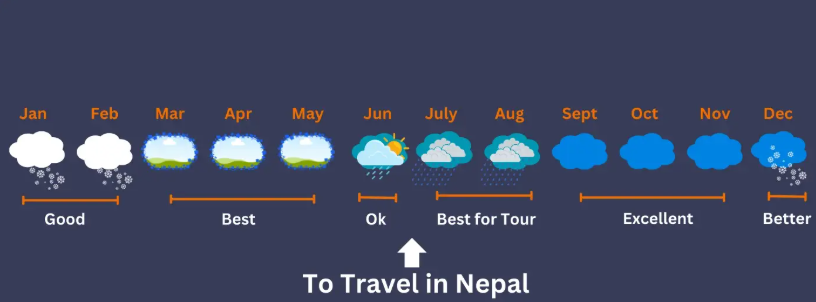
Best Time To Trek Manaslu Base Camp: Seasonal Breakdown

AUTUMN 2026 (September-November) BEST SEASON ⭐⭐⭐⭐⭐
Why Autumn is Objectively Best:
Crystal-clear skies with 85-95% visibility give you perfect mountain photography opportunities every day. Weather patterns are stable due to high-pressure systems, making conditions predictable and reliable for planning. The temperature ranges from -10°C to -5°C, which is ideal for physical exertion without extreme cold risk. Most critically, NMA permits cost only $175 (versus spring's $350, a $175 per-person difference!). Success rates are highest at 85-90%, meaning your training pays off.
Best Autumn Month: October combines peak clarity, optimal temperature, and settled weather patterns.
Autumn 2026 Complete Cost Breakdown:
- Package: $1,299-$1,499
- NMA Permit: $175 UPDATED September 1, 2025
- MCAP: $125
- Sagarmatha National Park: $25
- Khumbu Municipality: $20
- Total permits: $345
- Complete budget: $1,500-$1,700 per person
Autumn Challenges: Peak season attracts more trekkers (still 85% fewer than Everest), snow patches above 4,500m add challenge, and shorter daylight hours (10-11 hours).
Recommendation: Autumn is the CLEAR WINNER for most trekkers. Superior weather, best value, highest success rate.
SPRING 2027 (March-May) POPULAR BUT EXPENSIVE
Why Some Choose Spring:
Rhododendron wildflowers bloom along the entire lower trek in stunning colors (April is especially vibrant). Longer daylight hours (11-12 hours) allow more trekking time daily. Daytime temperatures are warmer (-5°C to 0°C), making initial trekking more physically comfortable.
Spring Downsides: NMA permits jump to $350 (double autumn cost!), representing +$175 per person. Afternoon clouds limit visibility to 60-70% (versus autumn's 85-95%, a significant difference for photography). Crowded teahouses in peak season sometimes force room sharing. Success rates drop to 80-85% (slightly lower than autumn). Lower elevations get muddy from spring rains. Total cost increase: +$500-650 per person for WORSE weather. The math doesn't work unless wildflowers are your primary objective.
Best Spring Month: April offers peak rhododendron bloom and clearest spring weather.
Spring 2027 Complete Cost:
- Package: $1,599-$1,799
- NMA Permit: $350 UPDATED September 1, 2025
- Additional permits: $170
- Total permits: $520
- Complete budget: $2,000-$2,150 per person
- Cost Difference: +$500-650 per person vs autumn FOR WORSE WEATHER
WINTER 2026-27 (December-February) EXPERTS ONLY
Why NOT Winter:
Extreme cold of -15°C to -20°C requires specialized gear that most recreational trekkers don't own. Visibility drops to 40-60% with frequent clouds and snow glare. The weather becomes unpredictable with frequent storms. Larkya La Pass becomes dangerously snow-covered with significant avalanche risk. Many teahouses close seasonally, limiting accommodation options. Success rates plummet to 60-70%, making reaching the base camp unlikely.
Strong Recommendation: Winter is NOT RECOMMENDED for recreational trekkers. Only experienced mountaineers with a winter expedition background should consider it. The risks outweigh the savings.
SUMMER/MONSOON 2027 (June-August) ABSOLUTELY AVOID
Why NEVER Trek in Monsoon:
Continuous rain brings 80%+ humidity and daily downpours that make hiking miserable. Visibility drops to 20-40% with constant clouds, mist, and rain blocking all views. Landslide risk increases dramatically as muddy trails become unstable and dangerous. Trail sections become flooded and often impassable, creating serious safety hazards. Success rates plummet to 40-60%, making reaching base camp unlikely.
Strong Recommendation: Monsoon season = 95% of trekkers skip for excellent reasons. The miserable conditions and danger aren't worth ANY savings.
Complete Cost Breakdown: Manaslu Base Camp Trek 2026-2027
Permit Costs (Updated September 1, 2025)
NMA Climbing Permit (Mandatory):
According to the Nepal Mountaineering Association official website, climbing permits have updated rates effective September 1, 2025:
- Autumn 2026: $175 per person UPDATED
- Spring 2027: $350 per person UPDATED
- Winter 2026-27: $200 per person UPDATED
- Summer 2027: $200 per person UPDATED
The NMA issues all climbing permits for trekking peaks in Nepal with seasonal pricing reflecting market demand and sustainable mountain tourism initiatives.
Manaslu Conservation Area (MCAP) Permit:
Issued by the Manaslu Conservation Area Project, this permit protects one of Nepal's most pristine mountainous regions.
- Cost: $125-150 per person
- Validity: 30 days from issue
- Purpose: Conservation funding and environmental protection
Additional Required Permits:
Sagarmatha National Park Entry Permit:
- Cost: $25 USD (Nepali Rupees 3,000)
- Reference: UNESCO World Heritage Site (Sagarmatha)
- Purpose: Park maintenance, trail upkeep, conservation
- Note: Required because the Manaslu region borders the Sagarmatha National Park
Khumbu Pasang Lhamu Rural Municipality Permit:
- Cost: $20 USD (Nepali Rupees 2,500)
- Issued by: Local Khumbu authorities
- Purpose: Local infrastructure and emergency rescue systems
- Collected at: Monjo checkpoint upon entering the region
Total Permit Costs by Season:
|
Season |
NMA |
MCAP |
Park |
Municipality |
TOTAL |
|
Autumn 2026 |
$175 |
$125 |
$25 |
$20 |
$345 |
|
Spring 2027 |
$350 |
$125 |
$25 |
$20 |
$520 |
|
Winter 2026-27 |
$200 |
$125 |
$25 |
$20 |
$370 |
TRANSPORTATION: KATHMANDU TO SOTI KHOLA (NO FLIGHTS)
Important Note: Unlike Everest Base Camp Trek (which uses Lukla flights), Manaslu Base Camp Trek requires NO FLIGHTS. The trek starts via overland transportation from Kathmandu to Soti Khola, the remote trailhead.
Why No Flights:
The Manaslu region has no airport access. It is one of Nepal's most remote mountain areas, accessed entirely by road. This remoteness is what makes Manaslu special — fewer crowds, more authentic experience, and true wilderness adventure.
KATHMANDU TO SOTI KHOLA (Trailhead): 7-9 Hour Drive
Three Transporatation Option
Public Bus (Budget Option)
-
Cost: $5-10 per person
-
Duration: 8-12 hours
-
Route: Direct bus from Kathmandu to Soti Khola
-
Comfort Level: Basic (crowded, bumpy mountain roads)
-
Best For: Budget travelers with flexible schedules
-
Booking: Through a trekking agency or direct at the bus station
-
Pros: Cheapest option, authentic local experience
-
Cons: Very crowded, long journey, unpredictable departure times
Shared Jeep (Recommended Balance) ⭐ POPULAR
-
Cost: $25-40 per person
-
Duration: 7-8 hours
-
Route: Multiple stops, scenic river valley views
-
Comfort Level: Good (4-6 people per jeep)
-
Best For: Groups, couples, value-conscious travelers
-
Booking: Through trekking agency (1-2 weeks advance)
-
Pros: Reasonable cost, comfortable pace, scenic route
-
Cons: Shared with other travelers, fixed departure times
Private Jeep (Most Convenient)
-
Cost: $150-250 per vehicle (split among group)
-
Duration: 6-7 hours (direct route, no stops)
-
Comfort Level: Excellent (your own dedicated vehicle)
-
Best For: Groups (3-4+ people), time-limited travelers, private groups
-
Per-Person Cost: $50-100 if split 3-4 ways
-
Pros: Fastest, most comfortable, flexible stops
-
Cons: Expensive if traveling alone
THE DRIVE EXPERIENCE
-
Route: Kathmandu → Prithvi Highway → Budhi Gandaki River Valley → Soti Khola
-
Road Condition: Mountain road (bumpy, winding, narrow in sections)
-
Scenery: Rural Nepal countryside, river gorges, traditional villages, rhododendron forests
-
Elevation Change: Kathmandu (1,400m) → Soti Khola (710m) then back up
-
Rest Stops: Usually 1-2 stops for lunch and facilities (2-3 hours for meals)
-
Vehicle Types: Toyota Hiace vans (most common), 4x4 jeeps, shared minibuses
Guide & Porter Costs
Lead Climbing Guide (17 days):
According to TAAN (Trekking Agencies Association of Nepal) 2026 guidelines:
- Daily rate: $50-70 USD
- 17-day total: $850-$1,190
- What your guide provides:
- Route navigation and decision-making
- Daily altitude health monitoring (pulse oximeter checks)
- Technical instruction (crampons, ice axes, rope techniques)
- Rope team leadership on steep sections
- Summit timing and weather decisions
- Emergency response coordination
- Cultural and historical interpretation
- Certification: NMA-licensed, 5+ years of Himalayan experience
High-Altitude Porters (1 per 2 climbers):
- Daily rate: $25-30 USD
- Load capacity: 20-25 kg per porter
- 17-day cost per 2-person team: $425-510 total
- Cost per climber (split 2-ways): $212-255
- What's included: Porter's meals, accommodation, insurance, gear carry
- Benefits: You trek with a daypack only (5-8 kg), porter carries your 20kg gear
Climbing Sherpa (Summit Day Support):
- Fixed fee: $350-450 (one-day summit support)
- Ratio: Typically 1 Sherpa per 2-3 climbers
- Responsibilities: Rope fixing, crevasse navigation, emergency support, summit day logistics
Total Guide/Support Cost: Usually included in the standard package price with Overland Trek Nepal
Accommodation & Meals (Complete 17 Days)
Kathmandu Hotels (Pre/Post Trek):
- 3-star hotel: $50-80 per night
- Total for 3 nights: $150-240
- Includes: Breakfast, room, and airport transfers
Teahouse Lodging (Days 3-16, 13 nights):
- Budget teahouse: $8-12 per night (twin sharing)
- Mid-range teahouse: $12-20 per night (higher altitude, more amenities)
- Total: $140-280 for 13 nights
- Includes: Basic room, communal dining
High Camp Tents (Days 10, 12 — 2 nights at altitude):
- Samagaun Base Camp tent: $20-30/night
- Total: $40-60 for 2 nights
- Includes: Expedition tent, sleeping pad, camp logistics
All Meals During Trek:
- Breakfast (teahouse): $5-8
- Lunch (packed trail food): $7-12
- Dinner (teahouse): $8-15
- Daily meal cost: $25-40 per person
- 17-day total: $425-680 per person
- Quality improves at altitude to maintain morale
Total Accommodation & Food: $755-$1,260 per person (usually included in package)
Optional Gear Rental (If Needed)
Where to Rent in Kathmandu:
- Shona's Alpine Rental (Thamel)
- Himalayan Guides Gear
- Sherpa Adventure Gear
- Mountain Hardwear Store
- The North Face Kathmandu
Typical Rental Gear & One-Time Costs:
- Mountaineering boots: $80-150 (CRITICAL must fit perfectly)
- Down sleeping bag (-25°C): $50-100 (essential at 4,800m)
- Down jacket: $40-80
- Down pants: $30-50
- Ice axe (B-rated): $20-40
- Crampons: $30-50
- Harness & helmet: $25-40
- Sleeping pad (R-value 5+): $20-40
- Trekking poles: $15-30
Total Gear Rental: $310-580 (deposit usually $200-400, refundable upon return)
Rental Tips:
- Reserve 1-2 weeks in advance (peak season books quickly)
- Try boots with climbing socks (test fit is critical for all-day comfort)
- Test crampon compatibility with boots (they must work together)
- Check sleeping bag condition and verify warmth rating (must be -25°C minimum)
- Get an itemized rental agreement in writing
Complete Cost Scenarios (Per Person) 2026-2027
Scenario 1: Budget Group Trek Autumn 2026
|
Item |
Cost |
Notes |
|
Package (group 4-6) |
$1,299 |
All-inclusive: guide, porter, accommodation, meals, transportation |
|
Permits |
$345 |
NMA $175, MCAP $125, Park $25, Municipality $20 |
|
Subtotal |
$1,644 |
|
|
Visa (Nepal) |
$50 |
On arrival at Tribhuvan International Airport |
|
Travel Insurance |
$200-250 |
Altitude coverage mandatory (helicopter evacuation insurance) |
|
Gear Rental |
$300 |
If needed (boots, sleeping bag, jacket, crampons, etc.) |
|
Tips (Customary) |
$250-300 |
Guide $100-150, porters $75-100 each |
|
Personal Expenses |
$200-300 |
Snacks, drinks, WiFi, laundry, extras |
|
Emergency Buffer |
$200-300 |
Weather delays, unexpected costs |
|
GRAND TOTAL |
$3,344-$3,544 |
Per person, all expenses included |
Daily Cost Breakdown: $197-209 per person per day
Scenario 2: Standard Group Trek Spring 2027
|
Item |
Cost |
Notes |
|
Package (group 3-4) |
$1,599 |
Premium season pricing, smaller group |
|
Permits |
$520 |
NMA $350 (spring highest), additional $170 |
|
Subtotal |
$2,119 |
|
|
Visa |
$50 |
On arrival |
|
Travel Insurance |
$250-300 |
Comprehensive altitude + evacuation coverage |
|
Gear Rental |
$350-400 |
Higher quality in peak season |
|
Tips |
$300-400 |
Higher gratuity expectations |
|
Personal Expenses |
$300-400 |
More activities, celebrations, extras |
|
Emergency Buffer |
$300-400 |
Peak season flexibility for delays |
|
GRAND TOTAL |
$4,229-$4,629 |
Per person |
Daily Cost Breakdown: $249-272 per person per day
Scenario 3: Premium Private Trek Spring 2027
|
Item |
Cost |
Notes |
|
Premium Package (1:1) |
$1,899 |
Private dedicated guide, maximum flexibility |
|
Permits |
$520 |
Spring rate |
|
Subtotal |
$2,419 |
|
|
Visa |
$50 |
On arrival |
|
Insurance |
$300 |
Premium coverage |
|
Premium Gear Rental |
$500 |
Top-tier equipment selection |
|
Tips (Generous) |
$400-500 |
Premium service expectation |
|
Personal Expenses |
$400-500 |
Celebrations, premium meals, activities |
|
Emergency Buffer |
$400-500 |
Flexibility for delays, contingencies |
|
GRAND TOTAL |
$5,029-$5,329 |
Per person, premium experience |
Daily Cost Breakdown: $296-314 per person per day
COST COMPARISON: MANASLU VS OTHER NEPAL TREKS
|
Trek |
Duration |
Cost |
Cost/Day |
Difficulty |
Crowds |
Best For |
|
Manaslu Base Camp ⭐ |
17 days |
$1,299-$1,799 |
$76-$106 |
Moderate-Hard |
Very low |
Complete circuit, solitude, authentic trek |
|
12-14 days |
$1,500-$2,500 |
$107-$178 |
Moderate |
Very high |
Iconic peak, established routes |
|
|
18-19 days |
$2,600-$4,100 |
$137-$216 |
Hard (technical) |
Low-Medium |
Mountaineering training |
|
|
18 days |
$2,950-$3,600 |
$164-$200 |
Hard |
Low |
Technical climbing, EBC region |
|
|
12-21 days |
$999-$2,000 |
$83-$167 |
Easy-Moderate |
Medium |
Complete loop, diverse terrain |
|
|
7-12 days |
$799-$1,500 |
$114-$214 |
Easy-Moderate |
Low-Medium |
Budget, short duration, nature |
|
|
8-10 days |
$699-$1,299 |
$87-$162 |
Easy-Moderate |
Low-Medium |
Budget, close to Kathmandu |
Key Takeaway: Manaslu offers the best value ($76-106/day) for serious trekkers wanting solitude and a complete circuit experience without crowds or premium pricing.
Altitude Sickness Management At Manaslu Base Camp
Understanding AMS at 4,800m
At Manaslu Base Camp (4,800m), atmospheric oxygen is approximately 50% of sea-level. Your body must adapt quickly, or Acute Mountain Sickness (AMS) develops.
AMS Risk at Each Elevation (Based on American Alpine Club Research):
|
Altitude |
AMS Risk |
Symptoms |
Management |
|
0-3,000m |
Very low |
None |
Normal |
|
3,000-4,000m |
Low (10-15%) |
Mild headache at night |
Continue trekking |
|
4,000-4,800m |
Moderate (20-30%) |
Headache, nausea, weakness |
Acclimatization hikes required |
|
4,800-6,000m |
High (30-50%) |
More pronounced symptoms |
Urgent descent if worsens |
Your Risk on Manaslu Base Camp Day (Day 10): 20-30% chance of mild AMS symptoms
Prevention: The Sleep-Low Protocol (CRITICAL)
Why It Works: Ascending and descending on the same day prevents your body from "setting" at altitude
The Strategy:
- Day 9: Sleep at Samagaun (3,530m)
- Day 10: Hike UP to Manaslu Base Camp (4,800m), stay 1 hour
- Day 10: Hike DOWN back to Samagaun (3,530m), sleep there
Result: Body experiences altitude stress but recovers to a lower elevation, preventing serious AMS progression.
Scientific Basis: American Alpine Club research shows "sleep-low" reduces AMS incidence by 50-60%.
Treatment: If AMS Develops
Mild AMS (Headache, Nausea):
- Stop ascending immediately
- Rest at the current altitude for 24 hours
- Hydrate: 500ml water immediately, then 250ml every hour
- Take medication: Ibuprofen 600mg every 4-6 hours + Diamox 125mg every 12 hours (if prescribed by doctor)
- Eat light foods frequently (appetite loss is normal)
- Monitor symptoms every 2-4 hours
- Continue next day ONLY if symptoms improve completely
Moderate AMS (Persistent Nausea, Weakness, Confusion):
- Descend 500m+ immediately
- Contact guide for medical decision
- Rest overnight at a lower altitude
- Aggressive hydration + medication
- May need to skip Larkya La Pass or return home
Severe AMS/HACE (Loss of Coordination, Hallucinations, Unconsciousness):
- DESCEND IMMEDIATELY medical emergency
- Call for a helicopter rescue
- Supplemental oxygen at base camp
- Hospital transfer likely needed
Travel Insurance is MANDATORY. Helicopter evacuation costs $8,000-$12,000. Standard travel insurance does NOT cover altitude. Get World Nomads, IMG Global, or Allianz Travel altitude coverage.
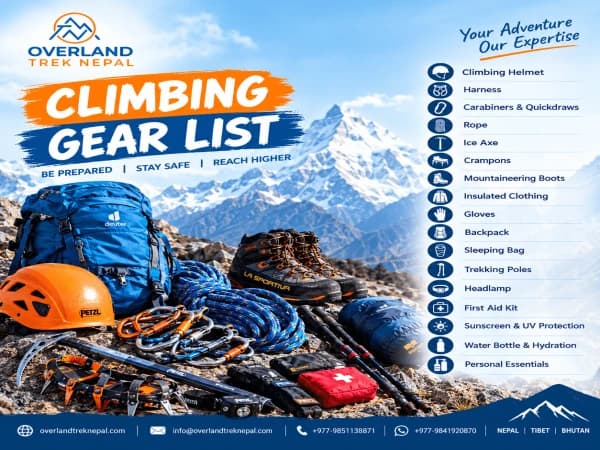
What To Pack For Manaslu Base Camp Hike
ESSENTIAL GEAR (Don't Trek Without)

Footwear:
- Waterproof trekking boots (broken in, ankle support) CRITICAL
- Thick wool hiking socks (3-4 pairs, change daily)
- Camp shoes/sandals (warm, comfortable for the lodge)
- Gaiters (optional, for snow sections)
Cold Weather Layers (4,800m = -10°C to -5°C):
- Thermal base layer top & bottoms (wool or synthetic, NOT cotton)
- Midweight fleece jacket (insulation layer)
- Waterproof down jacket (-25°C rated) CRITICAL FOR LIFE
- Waterproof down pants (-25°C rated) CRITICAL FOR HIGH CAMP
- Rain jacket + rain pants (weather protection)
- Wool hat, gloves/mittens (2 pairs, waterproof), balaclava/neck gaiter
Sleep System:
- Sleeping bag (-25°C rated minimum) CRITICAL FOR HIGH CAMP SURVIVAL
- Sleeping pad (R-value 5+, insulation essential for frozen ground)
Safety & Emergency:
- Headlamp + extra batteries
- First aid kit (blister treatment critical)
- Personal medications (bring enough + extra)
- Sunscreen SPF 50+ (critical at altitude, UV is intense)
- Insect repellent
- Toilet paper + wet wipes
Hydration:
- Water bottle (1-2 liter capacity)
- Water purification tablets
- Electrolyte powder (for altitude hydration)
OPTIONAL BUT RECOMMENDED
- Trekking poles (reduce knee strain on descent)
- Daypack (20-30L for daily items)
- Duffel bag (60L for the porter to carry)
- Compression packing cubes (organize gear)
- Camera or smartphone
- Lightweight quick-dry towel
- Toiletries + hygiene products
- Notebook + pen (journal your trek!)
17-DAY Complete Itinerary Overview

Days 1-2: Kathmandu Preparation (1,400m)
Day 1: Arrive at Tribhuvan International Airport. Meet your Overland Trek Nepal guide. Transfer to a 3-star hotel in Thamel. Welcome dinner, briefing, and equipment check.
Day 2: Sightseeing in Kathmandu. Visit Swayambhunath Temple and Pashupatinath Temple. Final permit processing and safety briefing. Rest, early sleep.
Day 3: KATHMANDU TO SOTI KHOLA (710m) — 7-9 HOUR DRIVE
Drive from Kathmandu through Prithvi Highway to Soti Khola. Stop for lunch along the way. Scenic drive through rural Nepal. Overnight at Soti Khola teahouse. Rest and prepare for trekking.
Days 4-9: Trek to Samagaun (710m → 3,530m)
Day 4: Soti Khola to Kyoropani (1,700m). 5-6 hours. Lush forest trek. Day 5: Kyoropani to Jagat (1,500m). 4-5 hours. Enter the restricted zone. Day 6: Jagat to Deng (2,160m). 6-7 hours. Gradual ascent. Day 7: Deng to Namrung (2,630m). 5-6 hours. Beautiful monasteries. Day 8: Namrung to Lho (3,180m). 4-5 hours. Continued ascent. Day 9: Lho to Samagaun (3,530m). 4-5 hours. REST DAY, acclimatization.
Day 10: MANASLU BASE CAMP SUMMIT ⭐ THE MAIN EVENT
See the detailed hour-by-hour breakdown earlier in this guide. This is the trek's main event!
Days 11-13: Larkya La Pass (3,875m → 5,160m)
Day 11: Samagaun to Samdo (3,875m). 4-5 hours. Day 12: Samdo to Dharamsala (4,460m). 4-5 hours. High camp. Early sleep (2 AM wake). Day 13: Dharamsala to Larkya La Pass (5,160m) to Bimthang (3,720m). 8-10 hours. THE CRUX, Epic sunrise, dramatic descent.
Days 14-16: Return to Kathmandu
Day 14: Bimthang to Tilije (2,300m). 5-6 hours. Day 15: Tilije to Besisahar (800m) via jeep. 6-7 hours. Exit the trek. Day 16: Besisahar to Kathmandu (drive). 6-7 hours. Rest at the hotel.
Day 17: Kathmandu Departure
Transfer to the airport. Depart Nepal.
FREQUENTLY ASKED QUESTIONS
How long is the hike to Manaslu Base Camp from Samagaun?
The round-trip hike from Samagaun to Manaslu Base Camp is 12-14 kilometers and takes 7-9 hours, including rest breaks. The elevation gain is 1,270 meters (3,530m to 4,800m). Most trekkers find it the most challenging day of the entire 17-day trek due to altitude and steep terrain combined.
What is the total cost for a Manaslu Base Camp trek in 2026-2027?
Total cost is $1,299-$1,799 per person for the complete 17-day trek, covering permits, guide, accommodation, all meals, and transportation from Kathmandu. Add $400-600 for visa, insurance, gear rental, tips, and personal expenses. Autumn 2026 is cheapest at ~$3,200-3,500 total per person; spring 2027 costs $4,200-4,600 due to higher permit fees.
What's the best time to trek Manaslu Base Camp: Spring or Autumn?
Autumn (especially October) is objectively superior. Clear skies (85-95% vs spring's 60-70%), cheapest permits ($175 vs $350), lower overall costs, highest success rate (85-90%), and stable weather. Spring offers rhododendrons, but it is 25% more expensive and cloudier. Choose autumn unless wildflowers are your primary objective.
Do I need previous trekking experience for Manaslu Base Camp?
Yes, prior experience is strongly recommended. You should have completed at least one high-altitude trek above 3,500 meters. Successfully completing the Everest Base Camp Trek or the Langtang Valley Trek prepares you well. Manaslu is not suitable for trekking beginners.
Can I do Manaslu Base Camp without a guide?
No, guides are mandatory by Nepalese law. The Manaslu region is a restricted trekking area requiring licensed guides and a minimum of 2 trekkers per guide. Beyond legal requirements, guides are essential for safety at an altitude of 4,800 m. Overland Trek Nepal provides NMA-certified guides with 30+ Manaslu summits each.
What altitude sickness risks are there at Manaslu Base Camp?
At 4,800m, your risk of mild AMS is 20-30%, manageable with built-in acclimatization days. Serious AMS is rare (5%) because of the "sleep-low" protocol (summit high, sleep low). Travel insurance covering helicopter evacuation ($8,000-12,000) is mandatory. American Alpine Club guidelines recommend 4-6 months of training to minimize risk.
Why Choose Overland Trek Nepal
- Overland Trek Nepal 15+ Years of Mountain Excellence
- NMA Certified: All guides of the Nepal Mountaineering Association are licensed
- TAAN Licensed Trekking Agencies Association of Nepal registered operator
- 450+ Summits Manaslu Base Camp treks completed successfully
- 85-90% Success Rate Industry-leading due to optimal 17-day itinerary
- Zero Fatalities 15+ years with perfect safety record
- 4.9/5 Stars Client satisfaction rating consistently high
- Transparent Pricing All-inclusive, no hidden fees
- Experienced Guides Average 30+ Manaslu summits per guide
Contact Overland Trek Nepal Today
Ready to summit Manaslu Base Camp in 2026-2027?
📱 WhatsApp: +977 9841920870 (fastest response)
☎️ Phone: +977 9851138871
📧 Email: info@overlandtreknepal.com
📍 Office: Narshing Chowk, Thamel, Kathmandu (Opposite Hotel Lo Mustang)
🌐 Website: overlandtreknepal.com
Final Thoughts
The Manaslu Base Camp hike is not just a trek, it's a complete Himalayan experience combining pristine wilderness, cultural immersion, personal challenge, and professional mountain adventure. At $1,299-$1,799 for 17 comprehensive days, it offers exceptional value compared to other Nepal trekking options.
With 85-90% success rates, professionally-trained NMA-certified guides, and a carefully-designed acclimatization itinerary, Overland Trek Nepal transforms your Himalayan dreams into reality.
The mountains are calling. Are you ready to answer? 🏔️


.webp&w=1200&q=75&dpl=dpl_HaARamNQt5LmifUAHiMkUhwikbgZ)