What Actually Counts as a Beginner Trek in Nepal?
A beginner trek in Nepal is a route under 4,800 meters that climbs gradually, stays on well-marked trails with teahouses every few hours, and can be completed by someone with basic fitness and no prior high-altitude experience. That rules out anything crossing a technical high pass or spending multiple nights above 5,000 meters; those need acclimatization experience most first-timers don't have yet. The table below sets out the best treks in Nepal for beginners by this definition, sorted from shortest to longest.
Nepal Beginner & Short Trek Comparison Table
The Short Langtang Valley Trek is graded Strenuous on its own trip page, not Easy or Moderate. It compresses what's normally a 6–7 day trek into 5 days, so the daily walking hours are longer. Fit beginners can do it, but if you want the easier version of Langtang, ask about the standard 10-day Langtang Valley Trekking itinerary instead.
1-Day Treks in Nepal
If you have just one day in Kathmandu and want a real taste of Himalayan trekking without an overnight, a 1-day trek in Nepal is the answer. These are guided hikes into the hills ringing the Kathmandu Valley, no permit headache, no altitude risk, back in your hotel by evening.
The Champadevi Day Hike climbs to 2,285 meters through pine forest to a hilltop temple with views of the Langtang Range and Ganesh Himal, and takes about 4–5 hours of walking. The Shivapuri Day Hike goes into Shivapuri National Park on the valley's northern rim, with a similar forest-and-viewpoint structure. Both are rated Easy and are genuinely suitable for families, kids, and anyone acclimatizing before a longer trek later in their trip.
2-Day Treks in Nepal
A 2-day trek in Nepal is the next step up, one night away from Kathmandu, still no real altitude exposure, but enough distance to reach a proper Himalayan viewpoint for sunrise.
The Chisapani Nagarkot Hike is the standard option here. It starts at Sundarijal, climbs through Shivapuri National Park to Chisapani (2,135m) for sunset, then continues to Nagarkot the next morning for a sunrise that, on a clear day, includes Everest itself along with the Langtang and Rolwaling ranges. It's graded Easy, costs from $250, and is one of the few short treks in Nepal explicitly marketed as family- and kid-friendly.
Short Treks in Nepal (3–5 Days): Poon Hill, Mardi Himal & Langtang Valley
This is the category most people mean when they search "short treks in Nepal" or "best treks in Nepal for beginners", enough days to genuinely feel like a Himalayan trek, without the two-week commitment.
Ghorepani Poon Hill Trek (4 Days)
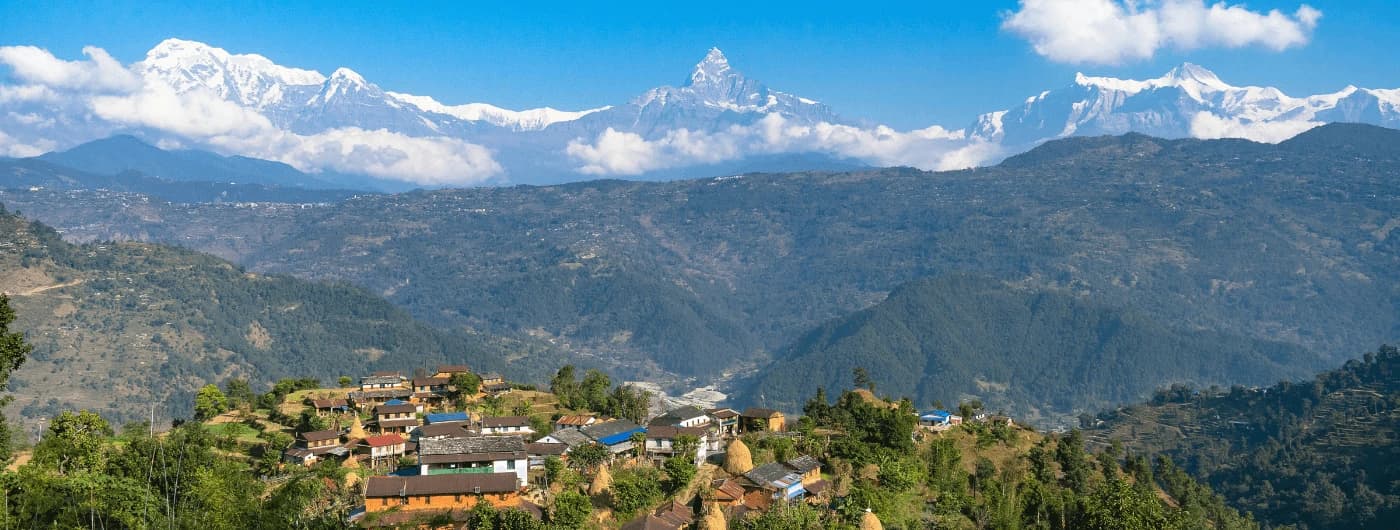
The Short Poon Hill Trek is arguably the single most beginner-friendly multi-day trek in Nepal. It climbs through Ulleri, Ghorepani, and Ghandruk in the Annapurna region to the Poon Hill viewpoint at 3,210 meters, timed for a sunrise over Dhaulagiri, Annapurna South, and Machhapuchhre (Fishtail). It's graded Easy, runs 4 days from Pokhara, and starts around $399. Because the altitude stays under 3,300m, it carries a genuinely low risk of altitude sickness, one of the few treks in this guide where that claim actually holds up against the numbers.
Mardi Himal Trek (5 Days)
The Mardi Himal Trekking route is a step harder than Poon Hill but still manageable for a fit beginner. It runs 5 days from Pokhara, tops out at 4,500 meters at Mardi Himal Base Camp, and is graded Moderate, mainly because of the steep, narrow ridge trail between High Camp and Base Camp. In exchange, you get close-up views of Machhapuchhre, Annapurna South, and Himchuli, and a noticeably quieter trail than Poon Hill or Annapurna Base Camp. Prices start around $499.
Langtang Valley Trek (5 Days)
The Short Langtang Valley Trek is the closest major trekking region to Kathmandu, a 5–6 hour drive rather than a flight, which is why "Langtang Valley trek" shows up so often alongside beginner searches. It's worth being upfront here: this particular 5-day itinerary is graded Strenuous and reaches 4,900 meters at Kyanjin Ri, which is a harder combination than Poon Hill or Mardi Himal. It's still achievable for a beginner with decent fitness, but if you'd rather have more acclimatization days at a gentler pace, the standard 10-day Langtang Valley Trekking itinerary is the easier version of the same region.
Best Treks in Nepal for Beginners Who Want the Full Experience (8–14 Days)
If you have more time and want the classic bucket-list routes, these are the two most realistic options for a first-timer, both of which include proper rest days for acclimatization.
Annapurna Ghorepani Poon Hill Trek (8 days, Moderate, 3,210m) extends the short Poon Hill route with more time in Ghandruk and the wider Annapurna foothills, a good choice if four days felt too short but you still want to stay under 3,500m.
Everest Base Camp Short Trek (12 days, Moderate, 5,364m at Kala Patthar) is the shortest reliable way to reach Everest Base Camp itself. It's higher and longer than everything else on this list, but the itinerary is built around proper rest days in Namche Bazaar, and the trail infrastructure, teahouses, other trekkers, rescue access, is the best-developed in Nepal.
What We Don't Recommend for a First Trek
Routes like the Everest Three High Passes Trek (18–21 days, crossing three passes above 5,400m) and the Gokyo Cho La Pass Trek (16–18 days, with rock scrambling at Cho La) are genuinely spectacular, but they're not beginner treks by any honest definition. They demand prior high-altitude experience and are better booked as a second or third Nepal trek, once you know how your body handles altitude.
Best Time for Beginner Trekking in Nepal
Spring (March–May) and autumn (September–November) are the best seasons for every trek on this list, whether it's a 1-day hike or the 12-day Everest Base Camp Short Trek. Both seasons bring stable weather and clear mountain visibility; spring adds blooming rhododendron forests, while autumn, right after the monsoon, typically has the sharpest, clearest views. Winter (December–February) is workable for the shorter, lower-altitude treks (Poon Hill, the day hikes, Chisapani Nagarkot) but gets cold and can close high passes. Monsoon (June–August) brings muddy trails and obscured views everywhere except the rain-shadow Mustang and Upper Dolpo regions, which aren't beginner routes anyway.
Cost & Preparation for Beginners
What a Short Trek Actually Costs
Based on the treks in this guide, a 1-day hike runs $99–$150, a 2-day hike around $200–$400, and a 4–5 day short trek like Poon Hill or Mardi Himal runs $350–$600 depending on group size and season. These typically include guide fees, permits, teahouse accommodation, and meals during the trek, but not international flights, Kathmandu/Pokhara hotel nights, or travel insurance. For a longer 8–14 day trek, budget $700–$1,500 all-in.
Physical Training
For anything beyond a 1-day hike, start training 4–6 weeks out with regular cardio, walking, stair climbing, or hiking with elevation gain, three to four times a week. You don't need athlete-level fitness for any trek in this guide except the Short Langtang Valley Trek and Everest Base Camp Short Trek, which reward extra preparation because of their pace and altitude.
What Permits Do You Need?
Permit requirements depend on the region. Annapurna-region treks (Poon Hill, Mardi Himal) need the TIMS card and an Annapurna Conservation Area Permit (ACAP). Langtang-region treks need the TIMS card and a Langtang National Park permit. Everest-region treks need the TIMS card and a Sagarmatha National Park permit. Day hikes around Kathmandu (Champadevi, Shivapuri, Chisapani Nagarkot) generally only need a national park entry fee and, since 2023, a licensed guide is mandatory for all trekking in Nepal regardless of duration. Your trekking agency typically handles all of this with a copy of your passport and photos.
Common Beginner Mistakes to Avoid
Overpacking. Three sets of trekking clothes are enough for any trek in this guide, even the longer ones; teahouses don't expect a fresh outfit daily.
Choosing by duration alone, not difficulty grade. A 5-day trek isn't automatically easier than an 8-day one; the Short Langtang Valley Trek (5 days, Strenuous, 4,900m) is objectively harder than the Annapurna Ghorepani Poon Hill Trek (8 days, Moderate, 3,210m). Check the difficulty grade and max altitude before booking on days alone.
Walking too fast on day one. This applies even on a 1-day hike. Starting slow saves energy and, on multi-day treks, reduces altitude sickness risk later.
Skipping the guide requirement. A licensed guide is now mandatory for all trekking in Nepal, including short hikes; it's not optional infrastructure, it's the law.
Safety Tips for First-Time Trekkers
Go slow at altitude. This matters even on treks that stay under 3,500m, like Poon Hill, though the risk is much lower than on Mardi Himal, Langtang, or Everest Base Camp, which all cross 4,500m or higher.
Get travel insurance that covers your specific max altitude. Travel insurance policies often have altitude caps; check that yours covers the highest point of your chosen trek, whether that's 2,285m (Champadevi) or 5,364m (Everest Base Camp Short Trek).
Don't trek alone, even on the shorter routes. A guide spots early altitude symptoms, handles permits, and adds cultural context you'd otherwise miss.
Pack for the altitude you're actually reaching. Check our full trekking gear list for Nepal; gear needs for a 1-day Kathmandu hike are very different from a 5-day trek crossing 4,500m.
Frequently Asked Questions
What are the best treks in Nepal for beginners?
Among the best treks in Nepal for beginners, the Short Poon Hill Trek (4 days, Easy, max 3,210m) is the top pick; it delivers real Himalayan sunrise views with the lowest altitude risk of any multi-day trek in the country. For those with only one day, Champadevi or Shivapuri Day Hike are the easiest true beginner options.
What is a good 1 day trek in Nepal?
The Champadevi Day Hike and Shivapuri Day Hike are the two standard 1-day treks near Kathmandu, both reaching around 2,285 meters through forest trails to a Himalayan viewpoint, and both rated Easy with no altitude sickness risk.
What is a good 2-day trek in Nepal?
The Chisapani Nagarkot Hike is the standard 2-day trek in Nepal, starting from Sundarijal near Kathmandu and reaching Nagarkot for a sunrise that includes Everest on clear days, all under 2,200 meters.
Is the Poon Hill trek suitable for beginners?
Yes. The Poon Hill trek (also called the Ghorepani Poon Hill trek) is graded Easy, tops out at 3,210 meters, and is widely considered the most beginner-friendly multi-day trek in Nepal, suitable for most fitness levels and families.
Is the Mardi Himal Trek good for beginners?
The Mardi Himal Trek is graded Moderate rather than Easy; it's manageable for fit beginners but includes a steep, narrow ridge section between High Camp and Base Camp at 4,500 meters, so it's a step up from Poon Hill rather than a direct equivalent.
Is the Langtang Valley trek good for beginners?
The 5-day Short Langtang Valley Trek is graded Strenuous and reaches 4,900 meters, making it harder than Poon Hill or Mardi Himal despite the similar trip length. Beginners with solid fitness can complete it, but the standard 10-day Langtang Valley Trekking itinerary is a gentler alternative with more acclimatization time.
What are the best short treks in Nepal?
The most popular short treks in Nepal for a 4–5 day window are the Ghorepani Poon Hill Trek, Mardi Himal Trek, and Short Langtang Valley Trek, each in a different region (Annapurna, Annapurna, and Langtang respectively) with different difficulty levels.
How fit do I need to be for a beginner trek?
For day hikes and the Poon Hill trek, basic fitness is enough; if you can walk uphill for 30 minutes without stopping, you're ready. For Mardi Himal, Langtang Valley, or Everest Base Camp Short Trek, 4–6 weeks of cardio training beforehand makes a real difference given the higher altitudes involved.
Can beginners do the Everest Base Camp trek?
Yes, via the Everest Base Camp Short Trek (12 days, Moderate, max 5,364m), which is the standard first-timer itinerary for the region and includes built-in rest days in Namche Bazaar for acclimatization.
Are the Everest Three High Passes and Gokyo Cho La treks suitable for beginners?
No. Both cross technical passes above 5,400 meters and typically run 16–21 days, requiring prior high-altitude trekking experience. They're better suited as a second or third Nepal trek rather than a first one.
Do I need a guide for a short trek or day hike in Nepal?
Yes. A licensed guide is now mandatory for all trekking in Nepal, including 1-day hikes like Champadevi and Shivapuri, not just the longer multi-day treks.
What permits do I need for a beginner trek in Nepal?
It depends on the region: Annapurna treks need a TIMS card plus an ACAP permit, Langtang treks need a TIMS card plus a Langtang National Park permit, and Everest-region treks need a TIMS card plus a Sagarmatha National Park permit. Day hikes near Kathmandu typically need only a park entry fee.
Conclusion
The best treks in Nepal for beginners depend entirely on how much time you have and how much altitude you're comfortable with, and that's a more useful way to choose than just picking whatever shows up first in a search. If you have one day, Champadevi or Shivapuri deliver real Himalayan views with zero risk. If you have a long weekend, Chisapani Nagarkot adds a proper sunrise. If you have four to five days, Poon Hill is the safest bet and Mardi Himal the more adventurous one, while Langtang Valley rewards those closer to Kathmandu who don't mind a faster pace. And if you have eight days or more, the Annapurna Ghorepani Poon Hill Trek or Everest Base Camp Short Trek are realistic first "big" treks with proper acclimatization built in.
Whichever one you choose, get in touch on WhatsApp, and we'll help you match the trek to your actual time and fitness, not just the one with the best-looking photos.
See you in the mountains!



.webp&w=1200&q=75&dpl=dpl_EUd5Wwb28cTzwN6qQNwTKfhuRohE)