
What is the Annapurna Base Camp Trek?
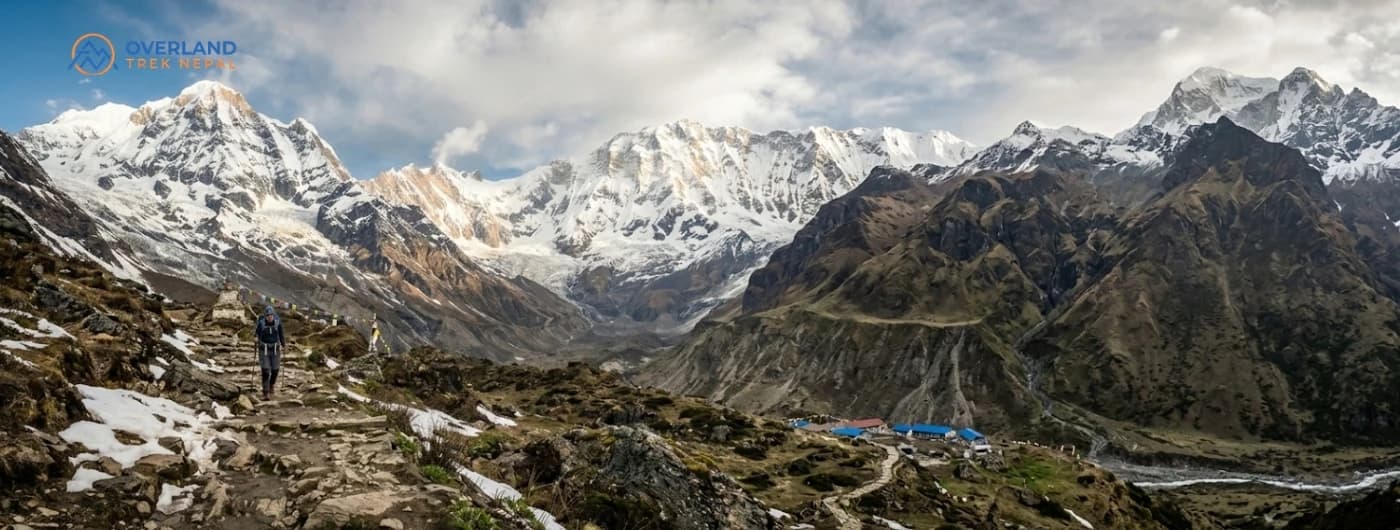
The Annapurna Base Camp (ABC) trek is one of the most celebrated trekking routes in Nepal. Nestled within the Annapurna Conservation Area, the trail winds through terraced farmlands, subtropical forests, traditional Gurung and Magar villages, and into a high alpine sanctuary surrounded by giants like Annapurna I, Machhapuchhre (Fishtail), Gangapurna, and Annapurna South.
The route reaches its highest point at Annapurna Base Camp, 4,130 metres above sea level, an open glacial amphitheatre that feels like standing inside a postcard. Along the way, trekkers also pass through Machhapuchhre Base Camp (3,700 m), making this one of the very few treks where you visit two base camps on the same trip.
What sets the ABC trek apart is its perfect balance of accessibility and grandeur. The trail starts low and ascends gradually, giving your body time to acclimatise. The cultural richness of villages like Ghandruk and Chhomrong, known for stone houses, local museums, and warm Gurung hospitality, adds a dimension beyond mountains alone.
Use this Annapurna Base Camp Guide to understand the route before you book.
Annapurna Base Camp Trek Itinerary (10 Days)
Below is a complete day-by-day ABC trek itinerary paced to balance acclimatisation, distance, and cultural immersion.
Day 1 Arrive in Kathmandu (1,400 m) | Rest day
- Airport pick-up and transfer to the hotel in Thamel by private vehicle
- Pre-trek briefing with your licensed guide; review gear and permits
- Evening: explore the vibrant markets and restaurants of Thamel
- Overnight at 3-star hotel in Kathmandu
Day 2 Kathmandu → Pokhara (820 m) | ~7–8 hrs drive · 200 km
- Scenic drive along the Prithvi Highway through hills and river valleys
- Arrive Pokhara by afternoon; check into lakeside hotel
- Optional: sunset walk along Phewa Lake
- Overnight at a 3-star hotel in Pokhara
Day 3 Pokhara → Nayapul → Ghandruk (1,940 m) | 2.5 hrs drive + 4–5 hrs trek
- Drive to Nayapul (1,070 m), the official ABC trailhead
- Trek through subtropical forests and terraced farmlands toward Ghandruk
- Explore Ghandruk, one of Nepal's largest and most beautiful Gurung villages
- Visit the local Gurung museum; panoramic views of Annapurna South
Day 4 Ghandruk → Sinuwa (2,340 m) | 6–7 hrs trek · 14 km
- Trek through the lively village of Chhomrong (2,170 m)
- Cross the Modi Khola river via a dramatic high suspension bridge
- Ascend steeply through bamboo and rhododendron groves to Sinuwa
- Landscape shifts noticeably as altitude increases
Day 5 Sinuwa → Deurali (3,200 m) | 6–7 hrs trek · 12 km
- Trek through Bamboo (2,310 m) and Dovan (2,600 m) along a narrow gorge trail
- Enter the alpine zone, dense forest gives way to open hillsides
- Possible wildlife sightings: Himalayan tahr, langur monkeys, eagles
- Arrive at Deurali, the last major stop before the high sanctuary
Day 6 Deurali → Annapurna Base Camp (4,130 m) | 4–5 hrs trek · 9–10 km
- Pass Machhapuchhre Base Camp (3,700 m) with dramatic views of the sacred Fishtail peak
- Enter the Annapurna Sanctuary, a glacial amphitheatre ringed by 7,000–8,000 m peaks
- Reach ABC at 4,130 m; check in, rest, and acclimatise
- Evening: 360° panorama of Annapurna I, South, Gangapurna, and Hiunchuli
Day 7 ABC → Bamboo (2,310 m) | 7–8 hrs trek · 18 km
- Wake before dawn to photograph the golden sunrise on Annapurna I — a defining memory
- Descend through MBC and Deurali following the ascent trail
- Descent is faster but requires careful footing, trekking poles strongly recommended
- Overnight at the Bamboo guesthouse in the lush forest zone
Day 8 Bamboo → Jhinu Danda (1,760 m) → Pokhara | 4–5 hrs trek + 28 km drive
- Morning trek down to Jhinu Danda, home of the famous natural hot springs
- Soak tired muscles in the riverside hot spring (small entry fee applies)
- Jeep ride from Jhinu Danda back to Pokhara (28 km)
- Overnight at a 3-star hotel in Pokhara, celebrate with your team
Day 9 Pokhara → Kathmandu | 7–8 hrs drive · 200 km
- Free morning in Pokhara, sunrise views of the Annapurna range from Phewa Lake
- Tourist coach departs mid-morning; scenic return drive to Kathmandu
- Farewell dinner in Kathmandu with your trekking guide
- Overnight at a 3-star hotel in Kathmandu
Day 10 Final Departure from Kathmandu | Airport transfer
- Collect your Overland Trek Nepal trekking appreciation certificate
- Private vehicle transfer to Tribhuvan International Airport
- Depart Nepal with Himalayan memories that last a lifetime
Annapurna Base Camp Trekking Route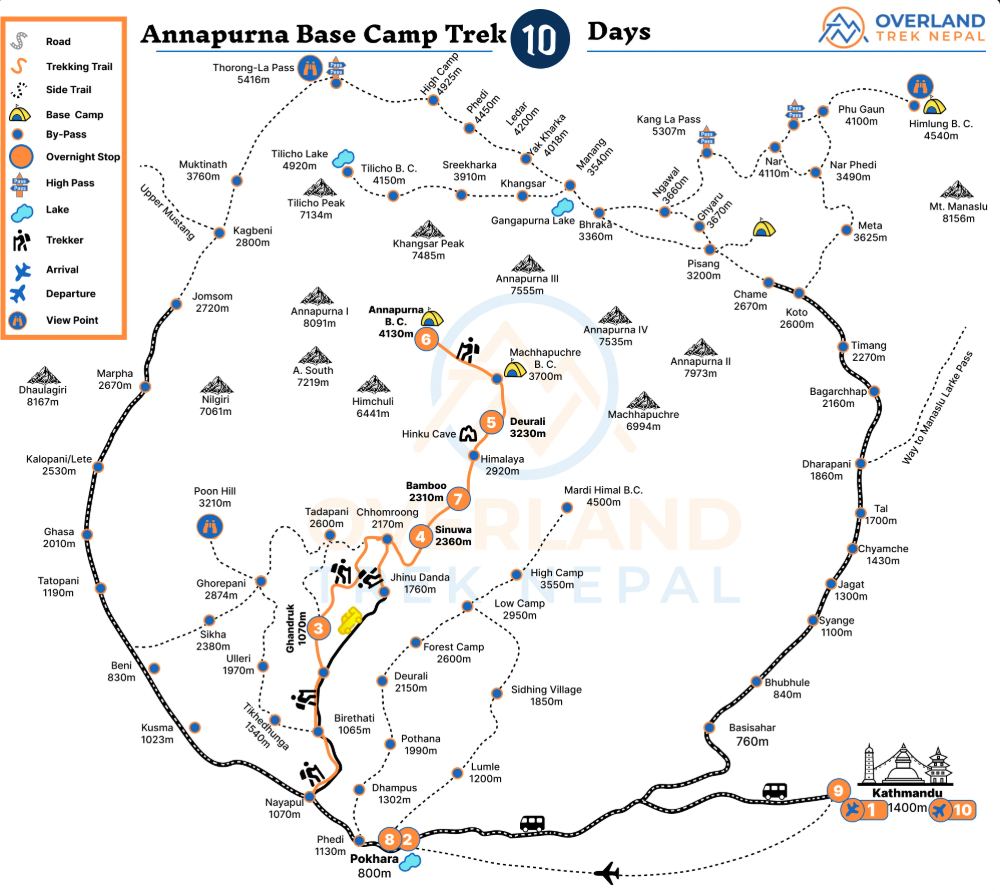
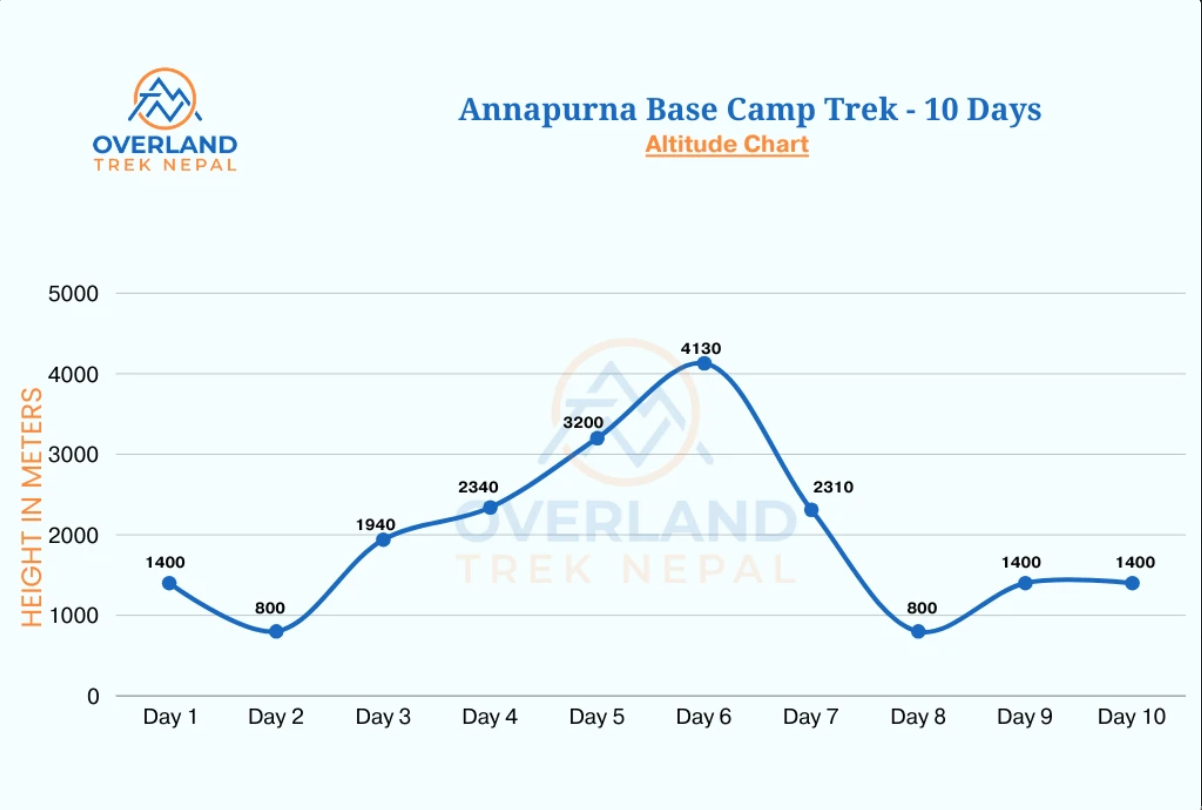
Annapurna Base Camp Altitude Chart
Annapurna Base Camp Trek Cost
The total cost of the ABC trek depends on your travel style, group size, and service level. Below is a transparent breakdown across three tiers for 2026. All prices are in USD per person.
|
Category |
Budget |
Mid-Range |
Luxury |
|---|---|---|---|
|
Package Price (10 days) |
~$999 USD |
~$1,200 USD |
~$1,599+ USD |
|
Trek Accommodation |
Basic teahouse |
Upgraded teahouse |
Best available room |
|
Ktm/Pokhara Hotel |
3-Star (BB) |
4-Star (BB) |
5-Star (BB) |
|
Meals (trek) |
Included — set menu |
Included + extras |
Included + extras |
|
Guide |
Licensed guide included |
Licensed guide included |
Senior guide included |
|
Porter (optional) |
$25/day (optional) |
$25/day (optional) |
Dedicated porter incl. |
|
ACAP + TIMS Permits |
Included |
Included |
Included |
|
Ktm–Pokhara Transport |
Tourist sofa bus |
Tourist sofa bus |
Private vehicle / flight |
|
Nepal Visa (separate) |
$30–$45 USD |
$30–$45 USD |
$30–$45 USD |
|
Guide/Porter Tips |
~$80–120 (customary) |
~$80–120 (customary) |
~$80–120 (customary) |
|
Travel Insurance |
~$50–150 (buy separately) |
~$50–150 (buy separately) |
~$50–150 (buy separately) |
Pro tip: Group size significantly lowers the per-person price. A group of 4–6 trekkers can reduce costs by 15–25% compared to solo travel. Contact Overland Trek Nepal for a custom group quote.
Annapurna Base Camp Trek Difficulty
Is Annapurna Base Camp Difficult? The Annapurna Base Camp trek is rated moderate, making it one of the most accessible high-altitude treks in the Himalayas. No technical climbing skills, ropes, or crampons are required.
Daily walking time: 4–8 hours depending on the day; 8–18 km per stage
Total elevation gain: approximately 3,000 m from Nayapul to ABC
Terrain: stone staircases, river bridges, forest paths, open ridges
Altitude ceiling: 4,130 m, altitude sickness is possible above 3,000 m
Fitness level: Regular walking fitness; 30–45 mins of daily walking for 4–6 weeks before the trek is ideal
Acute Mountain Sickness (AMS) is the primary health concern. Symptoms include headache, nausea, fatigue, and shortness of breath. The itinerary is paced to allow gradual acclimatisation. Drink 3–4 litres of water daily, avoid alcohol above 3,000 m, and always inform your guide at the first sign of persistent symptoms.
Best Time to Visit Annapurna Base Camp
The Annapurna trekking route is open year-round, but conditions vary significantly by season. Use the table below to choose the best time for your ABC trek.
|
Season |
Months |
Conditions |
Pros |
Cons |
|---|---|---|---|---|
|
Spring ★★ |
Mar–May |
Warm days, rhododendrons blooming, clear mornings. Peak season. |
Best scenery, stable weather, warm |
Busier trails — book ahead |
|
Autumn ★★ |
Sep–Nov |
Crystal-clear post-monsoon skies, crisp air, cultural festivals. |
Sharpest views, festive atmosphere |
Very crowded in October |
|
Winter |
Dec–Feb |
Cold, quiet trails. Snow above 3,000 m. Possible trail closures near MBC. |
Uncrowded, unique snow scenery |
Very cold; some closures |
|
Monsoon |
Jun–Aug |
Heavy rain, muddy paths, leeches, and limited mountain views. |
Lush greenery, low prices |
Landslide risk; poor views |
Verdict: October and November offer the clearest skies and sharpest mountain views. March and April deliver the most scenic trail, with blooming rhododendrons. Both are excellent for first-time trekkers.
Permits Required for ABC Trek
All trekkers on the Annapurna trekking route must carry two official permits, checked at multiple points along the trail. Ensure you have both before setting off from Pokhara.
|
Permit |
Details |
Cost (approx.) |
|---|---|---|
|
Annapurna Conservation Area Permit, required for all trekkers entering the Annapurna Conservation Area. Obtain in Kathmandu or Pokhara. |
NPR 3,000 (~$23 USD) |
|
|
The Trekkers' Information Management System is mandatory for all trekkers in Nepal. Provides emergency traceability. Available from Nepal Tourism Board offices. |
NPR 2,000 (~$15 USD) |
When you book a package with Overland Trek Nepal, both permits are arranged on your behalf. You must provide a passport copy and two passport-sized photos during pre-booking.
How to Reach Annapurna Base Camp
Getting to the ABC trailhead is a straightforward multi-stage journey that forms part of the adventure itself.
Step 1 — Fly into Kathmandu
Most international visitors arrive at Tribhuvan International Airport, Kathmandu. Direct flights operate from Delhi, Mumbai, Bangkok, Dubai, Doha, and many other hubs.
Step 2 — Kathmandu to Pokhara
Two options: a 7–8 hour scenic bus journey (200 km) along the Prithvi Highway, or a 25-minute domestic flight (~$106 one-way per person). The flight is strongly recommended if time is limited.
Step 3 — Pokhara to the Trailhead
From Pokhara, a private jeep or shared vehicle takes you to Nayapul (approx. 2.5 hours), where the trekking begins. On your return, transport is arranged from Jhinu Danda Bridge back to Pokhara.
Packing List for Annapurna Base Camp Trek
Packing smart is critical. You will carry a 20–30 L daypack on the trail; a porter carries your main duffel (up to 10 kg per person). Keep it light — your joints will thank you.
Clothing
- Thermal base layers, top and bottom
- Fleece mid-layer jacket
- Down jacket (essential above 3,000 m)
- Windproof and waterproof shell jacket
- Hiking trousers × 2 pairs
- Woollen hat and gloves
- Sun hat or trekking cap
- Neck gaiter or buff
- Moisture-wicking trekking socks × 4–5 pairs
- Waterproof hiking boots, broken in before the trek
- Lightweight camp sandals or flip-flops
Gear & Equipment
- Trekking poles, highly recommended for descents
- Sleeping bag rated to -10°C
- Daypack 20–30 L
- Main duffel bag 60–70 L (for porter to carry)
- Reusable water bottles × 2 (1 L each)
- Water purification tablets or filter
- Headlamp with spare batteries
- Sunglasses with UV400 protection
- Rain cover for backpack
Health & Hygiene
- Personal first aid kit, blister pads, bandages, ibuprofen
- Altitude sickness medication: Diamox (consult your doctor in advance)
- Sunscreen SPF 50+ and lip balm with SPF
- Hand sanitiser and wet wipes
- Toilet paper, limited supply at high-altitude teahouses
- Quick-dry travel towel
- Insect repellent
Tech & Documents
- Passport + permit copies, keep originals secure
- Travel insurance documents, must cover 4,000+ m altitude
- Power bank, electricity at teahouses costs $2–5 per charge
- Universal power adapter
- Offline maps downloaded (Maps.me or Gaia GPS)
- Nepal SIM card with data, available at Kathmandu airport
- USD cash, no ATMs beyond Chhomrong village
Tips for First-Time Trekkers
- Early October and late March offer the best mix of clear weather and manageable trail traffic. Avoid mid-October if you want quieter teahouses. Book during shoulder season.
- 4–6 weeks of regular walking, especially on stairs or hills, will make a dramatic difference to your comfort and enjoyment on the trail. Train before you go.
- Beyond navigation, a local guide provides cultural context, emergency support, and early detection of altitude sickness. It is the single most impactful thing you can do for your safety. Hire a licensed guide.
- Never ascend more than 500 m per day above 3,000 m. Persistent headache or nausea means descend immediately. The rule: climb high, sleep low. Acclimatise properly.
- No ATMs exist beyond Chhomrong. Cards are not accepted on the trail. Budget for hot showers, device charging ($2–5), and personal snacks. Carry sufficient Nepali rupee cash.
- 3–4 litres of water per day is your most powerful defence against altitude sickness. Avoid alcohol above 3,000 m, it dehydrates and masks AMS symptoms. Drink water, not alcohol.
- Your policy must cover high-altitude trekking (above 4,000 m), emergency helicopter evacuation, and medical costs. This is non-negotiable. Get the right travel insurance.
For a fully guided 10-day experience including guide, porter, and all permits, see our Annapurna Base Camp Trek package starting from US$799.
Frequently Asked Questions
Is the Annapurna Base Camp trek difficult?
The ABC trek is rated moderate. It involves 5–8 hours of walking per day on well-maintained trails, reaching a maximum altitude of 4,130 m. No technical climbing is required. The main challenge is altitude, but the paced itinerary and gradual ascent keep risk manageable for most healthy, reasonably fit trekkers.
Can beginners do the ABC trek?
Yes, the Annapurna Base Camp trek is one of the most beginner-friendly high-altitude treks in Nepal. With a comfortable 10-day itinerary, a licensed guide, and 4–6 weeks of physical preparation (regular walking), most healthy adults with no prior trekking experience can complete it successfully.
Do I need a guide for the ABC trek?
Hiring a licensed guide is strongly recommended, though not legally mandatory. A guide provides navigation, cultural insight, emergency support, and can identify early signs of altitude sickness. Solo trekkers have encountered serious difficulties on this route. For your safety and a richer experience, trekking with a guide is the smart choice.
What is the total cost of the ABC trek?
A complete 10-day ABC trek package costs between $999 and $1,599 USD, including guide, permits, meals, accommodation, and transport. Additional costs include Nepal visa ($30–45), travel insurance ($50–150), and tips ($80–120). Budget a total of approximately $1,200–$1,800 USD all-in.
What is the altitude of Annapurna Base Camp?
Annapurna Base Camp sits at 4,130 metres (13,550 feet) above sea level. The trail also passes through Machhapuchhre Base Camp at 3,700 m. While these altitudes can cause mild altitude sickness, the gradual ascent profile of this trek keeps the risk low for trekkers who pace themselves correctly.
What is the best time for the ABC trek?
Spring (March–May) and Autumn (September–November) are the best times for the ABC trek. These months offer stable weather, clear mountain views, and safe trail conditions. October is the most popular single month. Winter is possible but cold above 3,000 m, and the monsoon season (June–August) is generally not recommended.
.webp&w=1200&q=75&dpl=dpl_EUd5Wwb28cTzwN6qQNwTKfhuRohE)
.webp&w=1200&q=75&dpl=dpl_EUd5Wwb28cTzwN6qQNwTKfhuRohE)